News

We are delighted to welcome Nina Schnyder and Stephan Minger to the team and congratulate Andreas Stritt on his promotion.
Andreas Stritt has been with Swiss Economics since 2022 and has been promoted to Economist. He focuses on energy, transport and competition economics. He earned a Master's degree in economics from the University of Berne, with a focus on data analysis and industrial economics.
Nina Schnyder also joins the team as an Economist. She holds a Master's degree in Environmental Economics from the London School of Economics. After graduating, she worked as an energy and environmental consultant in London and Berlin and will continue to specialize in these areas at Swiss Economics.
Stephan Minger joins Swiss Economics as an Analyst. He holds a Master's degree in Economics from the University of St. Gallen with a focus on financial economics and data analysis. During his studies, he worked as a reasearch assistant in the areas of financial market econometrics, derivatives and monetary policy.
We are confident that their skills and experience will be a valuable addition to our team.

We warmly welcome Winand Emons to our team as a consultant!
We are pleased to welcome Prof. emer. Dr. Winand Emons as a counsel to the Swiss Economics team. He strengthens our team especially in the area of competition economics. Winand Emons has not only distinguished himself in research and teaching at the University of Bern, but has also held important positions as a member of the Competition Commission, Dean and Vice-Dean of the Faculty of Business, Economics and Social Sciences and a member of the Research Commission of the Swiss National Science Foundation (SNSF). His work in his main research focus in the areas of law and economics, microeconomics and competition economics led to numerous publications in renowned journals.
We warmly welcome Winand Emons and wish him success and pleasure in his new activities for Swiss Economics.

Swiss Economics has supported the AZ Regionalfernsehen AG and CH Media in their applications for broadcasting licenses for the years 2025 to 2034.
AZ Regionalfernsehen AG successfully applied with Tele M1 and TeleBärn for the broadcasting licenses in the Aargau/Solothurn and Bern regions. An expert opinion from Swiss Economics was submitted as part of the application. Swiss Economics prepared a second report for CH Media too, that led to a similar success. CH Media has acquired with Radio Central the local radio broadcasting license for the Central-Switzerland region.
Our reports examined in particular the influence of the award of the license on the diversity of offerings and opinions. The focus was on the conflict of objectives between the strict structural independence of broadcasters and their possibility of offering a diverse program. The positive externality of media content for democratic decision-making, which justifies state support for public service, only exists if viewers are truly interested in the broadcasted content. Very small, but structurally independent media providers are usually unable to build up the necessary reach with their limited financial resources, e.g. due to the lack of economies of scale. In addition, there are strong incentives to provide a diverse program, particularly in concentrated media markets.
Swiss Economics concludes in its reports that the synergy benefits and the strengthening of regional media in journalistic competition outweigh any concerns regarding structural independence.
Click here for the project entry on our website.

We welcome Maida Sabotic and Elena Zarkovic to our team and congratulate Seline Spillman and Leah Meyer de Stadelhofen on their promotions.
Seline Spillmann joins our team as Economist. Her focus is on data analysis in various topics as well as labor economics. Among other things, she is active in the fields of competition economics and health. In her master she studied economics at the University of Zurich with a focus on econometrics. During her studies, she worked as a Research Assistant in the area of globalization and labor markets at the University of Zurich.
Elena Zarković joins us as an analyst. She studied economics and business administration in her bachelor's at the University of St. Gallen, where she also earned an additional certificate in Data Science Fundamentals. During her studies, she worked as a research assistant at the Swiss Institute for International Economics and Applied Economic Research at the University of St. Gallen.
Maida Sabotic joins the Swiss Economics team as an Economist. Her areas of expertise include economic policy and data analysis. She holds a Bachelor's degree in Economics, Politics and History from the University of Zurich as well as Master's degree in Economics and Data Science. During her studies she worked at the Institute of Economics at the University of Zurich. After her Master's degree, she completed an internship in economic development cooperation at the State Secretariat for Economic Affairs.
Leah Meyer de Stadelhofen joins our team as an Economist, focusing on behavioral economics, industrial economics and data analysis. Her areas of expertise include regulation, environmental economics, and energy. In addition, Leah joins our Romandie department and is thus involved in the development of Swiss Economics in French-speaking Switzerland and France. She holds a Master in Economics from the University of Lausanne with a specialization in Behavior, Economics, and Evolution. During her studies, she worked as a Teaching Assistant in Microeconomics.
We congratulate all of them and wish them much success and joy in their new activities for Swiss Economics.

We warmly congratulate our staff member, Nicolals Greber, on receiving the ACCL Award for his Master's thesis! The award ceremony took place on 19 September at the Atelier de la Concurrence in Bern.
In his Master's thesis, Nicolas Greber examined the behaviour of self-learning pricing algorithms. Recent studies have shown that certain AI pricing algorithms are able to learn tacit collusion in oligopoly models. Nicolas picked up there with his master's thesis, analysing the behaviour of two more recent AI pricing algorithms. The first algorithm, known as the "deep deterministic policy gradient", failed to achieve constant convergence. In contrast, the second algorithm, the "multi-agent deep deterministic policy gradient", achieved consistent results in a Nash equilibrium. These findings were confirmed by various robustness tests.
We wish Nicolas all the best and success in his PhD at the University of Zürich and in his work for Swiss Economics.

Last weekend we celebrated our 15th anniversary with a visit to the power station, dinner and an overnight stay at the Grimsel Hospiz!
Last weekend we spent an unforgettable time together at the Grimsel Hospiz, surrounded by the breathtaking scenery of the Grimsel region.
Highlights included exciting excursions to the hydroelectric power plant and the impressive Aare Gorge, and a delicious 5-course meal. These experiences deepen our appreciation for 15 years of successful projects.
As passionate economists, we are proud of our continuous growth. This journey would not have been possible without our dedicated team and inspiring projects.
Here's to the next exciting chapters full of success and exciting projects!

In a recent presentation at the Blockchance conference in Hamburg, Matthias Hafner explored the factors that influence the stability of stablecoins and discussed how they relate to recent developments in CBDCs and the tokenization of real-world assets.
Drawing from recent literature, including his own research conducted at the University of Zurich, Matthias Hafner emphasized that the construction and management of collateral are key determinants of stablecoin stability. While externally derived collateral value may compromise the independence of the stablecoin ecosystem, collateral value derived from within the ecosystem carries the risk of death spirals, as observed with TerraUSD. Additionally, centralized management may offer cost-effectiveness but exposes the stablecoin ecosystem to the risk of bank runs, as exemplified by the recent USDC depeg incident.
Further, Matthias Hafner argued that the advent of CBDCs and tokenized real-world assets could potentially put pressure on the demand for stablecoins in the future. This could, for example, result in the need to introduce solutions for stablecoins that offer interest payments based on their underlying collateral.
More detailed information can be found here:
Blockchance presentation slides
Matthias Hafner's research on stablecoins

We are happy to announce that Matthias Hafner has been promoted to Principal. Nicolas Oderbolz has been supporting our team as an Economist since the beginning of this year.
Matthias Hafner supports our team with immediate effect as a Principal and remains the Director of the Center for Cryptoeconomics.
His areas of expertise include financial services, blockchains and cryptoassets.
With his expertise and many years of experience, he will continue to make an indispensable contribution to the further development of these areas. Matthias regularly advises large companies and public authorities and supports start-ups in the implementation of their projects. In addition, he is writing his dissertation and teaches at the University of Zurich on various crypto topics. Before joining Swiss Economics in 2016, he worked at the Competition Commission.
Nicolas Oderbolz has joined Swiss Economics as an Economist with a focus on regulation, health and blockchain. He is involved in various projects in the fields of energy, data analytics and cryptoassets.
Nicolas completed his Bachelor and Master studies in Economics at the University of Zurich, with a focus on empirical methods and data analysis. During his studies, he worked as a research assistant at the University of Zurich in the field of labour and development economics. He has been a valuable part of the Swiss Economics team since the summer of 2022.
We congratulate both of them and wish them much success and joy in their new activities for Swiss Economics.

The article "Blockchain und ihre Anwendungen" by Matthias Hafner and Dr. Christian Jaag was recently published in the quarterly issue of the zsis) Centre for Swiss and International Tax Law.
In their contribution, they explain how blockchain works through illustrative examples and use cases. In addition, they explain the legal classification of crypto-assets and show the limits of the technology.
The publication can be accessed here.

Matthias Hafner presented his research on stablecoins at the Wolfram ChainScience conference in Boston, USA.
The article, "The Four Types of Stablecoins: A Comparative Analysis" (jointly with Marco Henriques Pereira, Prof. Dr. Helmut Dietl, and Juan Beccuti) discusses the conditions under which stablecoins may lose their value. Among others, they explore the crash of Terra and the de- and re-peg of the USDC stablecoin.
Link to the slides: The Four Types of Stablecoins (swiss-economics.ch)

In less than a week, the Shanghai-update is going to be realized on the Ethereum Beacon Chain. This long-anticipated event in the blockchain community motivated us to discuss and compare staking designs of different blockchains in a series of blog post.
In our second blog post of this series, we analyze and compare the staking designs of different blockchains from an economic perspective. To make the information more accessible and compact, we also created a table which can serve as a quick reference.
You can find the whole publication and our new Company Profile on Medium.
Don't hesitate to follow us there to stay updated on our upcoming publications!

Matthias Hafner and Nicolas Greber were awarded first and third place at BBA's 5th Scientific Conference for their research presentations.
Matthias Hafner and Nicolas Greber, two of our blockchain researchers, have made their mark at BBA's 5th Scientific Conference, with first and third place awards for their research presentations.
Matthias explained the recent depeg of the second largest stablecoin USDC and under what conditions stablecoins could lose their value. The paper and slides were created in collaboration with Marco Henriques Pereira, Juan Beccuti and Helmut Dietl.
Nicolas proposed mechanisms for handling liquidity risk using the DeFi lending platform Folks Finance. The paper and slides are the result of joint work with Matthias Hafner, Romain de Luze, Juan Becutti, Benedetto Biondi, Gidon Katten, Michelangelo Riccobene, and Alberto Arrigoni.
More about the British Blockchain Association.

Swiss Economics presents the study "Effectiveness of Corona Measures in Switzerland "
Effectiveness of Corona Measures in Switzerland
Michael Funk presented our study “Effectiveness of Corona Measures in Switzerland” at the 4th Workshop of the Swiss Network on Public Economics (SNoPE). The network aims to strengthen the ties between academics, public administration, the Swiss National Bank and private institutions such as Swiss Economics. This is exactly the intersection we address in almost all of our projects. The study provides important insights into the effectiveness of individual Corona measures in Switzerland. In addition, as the discussion at SNoPE also showed, important lessons can be learned about the opportunities and challenges of empirical evaluation for the public sector. In particular, meeting academic standards and solving non-trivial identification problems while facing time and budget constraints.

In light of the Shanghai update of the Ethereum blockchain, which allows stakers to unstake their ETH, we find it timely to investigate crypto staking in a series of upcoming blog posts.
In our first blog post, we explain the basic terms, economics and mechanisms of staking designs. Later, we compare the staking designs of seven different blockchains.
You can find the whole publication and our new Company Profile on Medium.
Don't hesitate to follow us there to stay updated on our upcoming publications!

Ramon Gmür joins the team as Economist, Romain de Luze promoted to Senior Economist.
Ramon Gmür strengthens our team as an Economist focusing on economic policy, regulatory economics and data analysis. Ramon studied economics, politics and history in his Bachelor's degree at the University of Zurich. He holds a Master’s degree in Economics and Data Science from the University of Zürich, with a special focus on Econometrics and Statistics. During his studies, he worked several years for two chairs at the University of Zurich. Prior to his studies, he worked for a major Swiss bank and earned the business title “Wirtschaftsfachmann KSZH.
Romain de Luze has been promoted to Senior Economist with a focus on regulation, data analytics and risk management. His areas of expertise include energy, financial services and cryptoassets. Additionally, Romain is involved in the development of Swiss Economics in French-speaking Switzerland and France. He holds a Master’s degree in Actuarial Science from the University of Lausanne and a Master’s degree in Economics from the University of Berne. Before Swiss Economics, he worked for several years as a quantitative analyst for a reinsurance company in Zurich.
We congratulate both of them and wish them much success and fun in their new activities for Swiss Economics.

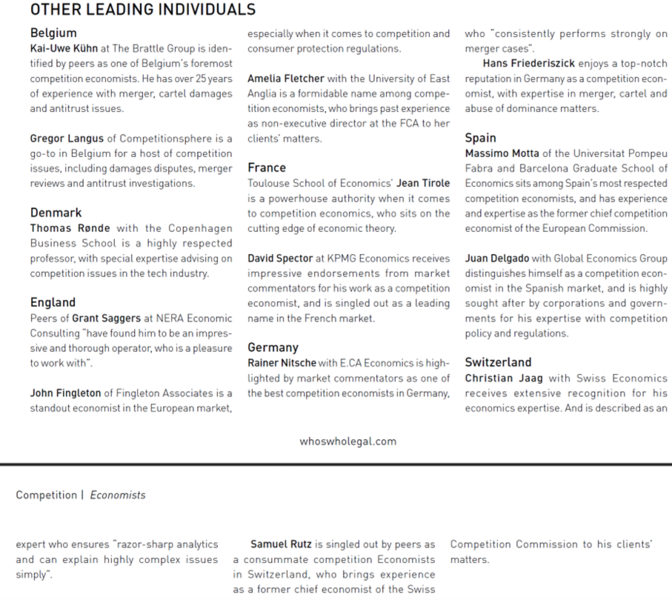
Christian Jaag and Samuel Rutz were awarded "Leading Practitioners" by WWL in the category of Competition Economics.
Every year, Who's Who Legal identifies the world's leading competition economists. This year, Swiss Economics is represented twice - by Christian Jaag and Samuel Rutz - in the illustrious circle of "Leading Practitioners" in Europe (EMEA). We would like to thank our clients for the great trust they place in us.
WWL on Christian Jaag and Samuel Rutz:
Christian Jaag of Swiss Economics receives a lot of recognition for his economic expertise. And is described as an expert who "ensures razor-sharp analyses and can explain highly complex issues simply".
Samuel Rutz is described by peers as an outstanding competition economist in Switzerland who brings his experience as former Chief Economist of the Swiss Competition Commission to bear on the concerns of his clients.

What possibilities are there for using Blockchain Technology to make processes in the creation of value with IP more secure, transparent and efficient? A study for the Swiss Federal Institute of Intellectual Property (IPI).
Intellectual property, for example in the form of patents or copyrights, protects inventors from free riders and thus creates incentives to invest more in research and development and in creative works. IP is also relevant to the rapidly developing field of Blockchain Technology and applications. IPI would like to better assess the current and, more importantly, future demand for IP-services.
As part of this study, we are conducting a survey to which we would like to cordially invite you. The outcome of this survey will be key in shaping the IPI's services related to blockchain and IP. You can participate in the survey until October 31, 2022 over the following link: www.swiss-economics.ch/ip-survey.html.
If you are active in the field of Blockchain and/or IP, we would be delighted to incorporate your opinions, experience and expertise in this study.

We have a new Logo!
Swiss Economics has a new logo. It was designed by Diego Bally and symbolizes our abbreviation "SE". The majority of its components are pointing upwards. The logo represents our development so far and our vision for the next years. Since September, it has decorated our office windows.
The new logo will be rolled out gradually over the next weeks and months. First, we will adapt our web presence, then we will implement it in our documents.
We hope you like it!

Beatrix Marosvölgyi joined our team as an Economist. Her focus lies in environmental and political economics.
Beatrix’s expertise lies in environmental economics, regulatory impact assessments and digital markets. She completed her bachelor's degree in economics at the University of Lucerne and her master's degree at the University of Bern with a focus on environmental economics. Her master's thesis focused on the change in air pollutants due to the aircraft grounding in U.S. airspace after the 9/11 terrorist attacks.
During her studies, Beatrix worked for Swiss Post, the Universities of Lucerne and Bern, and Ernst & Young. She joined Swiss Economics in 2022 as an Analyst.
She is proficient in German and English with mother tongue Hungarian.
We wish Beatrix all the best for her future at Swiss Economics.

The Center for Cryptoeconomics partners with proof-of-stake Blockchain Algorand
Swiss Economics' Center for Cryptoeconomics (cryptecon) joins the Partner Program to intensify its services in the Algorand ecosystem. Algorand is a pure proof-of-stake blockchain focused on the convergence between decentralized and traditional finance. A perfect match for cryptecon with its strong expertise in tokenomics and protocol design for DeFi projects. Previously, cryptecon already advised several Algorand projects such as Folks Finance and Pact. We are now looking forward to intensifying our efforts on Algorand and providing our services as a Preferred Partner.
Algorand creates a green Blockchain with strong focus on efficiency and is exclusive Blockchain Partner of FIFA’s Men’s World Cup 2022 and official Sponsor of FIFA’s Women’s World Cup 2023.

More about Algorand.

We are pleased to announce that Nicolas Greber has joined the team as an Economist. His focus is on competition economics and data-driven analysis including artificial intelligence.
Nicolas Greber holds a bachelor's degree in economics with a focus on industrial economics from the University of Bern. He is currently completing his Master's degree in Economics at the University of St. Gallen with a thesis on the impact of artificial intelligence on competition.

How to design a Swiss Innovation Fund?
The Federal Council wants to strengthen Switzerland as a location for start-ups. On June 22, 2022, it made a decision in favour of a Swiss Innovation Fund. This is intended to improve the financing ecosystem of start-ups during the growth phase (to the press release).
In this context, Swiss Economics was commissioned by SECO to conduct a study on the fundamentals of such an Innovation Fund. The focus was on identifying international best practices and evaluating possible governance options for a Swiss Innovation Fund (Swiss Economics report).