News

Swiss Competition Commission (COMCO) cleared the transaction Sunrise | Liberty Global. Swiss Economics accompanied the examination from the outset with economic expertise.
Swiss Economics unterstütze Sunrise in diesem Verfahren in enger Zusammenarbeit mit der Anwaltskanzlei Lenz & Staehelin. Unser Team umfasste Samuel Rutz, Michael Funk, Matthias Hafner und Christian Jaag.
Swiss Economics hatte Sunrise bereits im letztjährigen Fusionskontrollverfahren bezüglich der umgekehrten Transaktion erfolgreich unterstützt. Schon damals hatte die WEKO den Zusammenschluss nach vertiefter Prüfung bedingungslos freigegeben. Anschliessend lehnte jedoch die Mehrheit der Aktionäre/innen die Übernahme ab. Nach erneuter Prüfung kam die WEKO zum Schluss, dass die Marktverhältnisse seither weitgehend unverändert blieben.

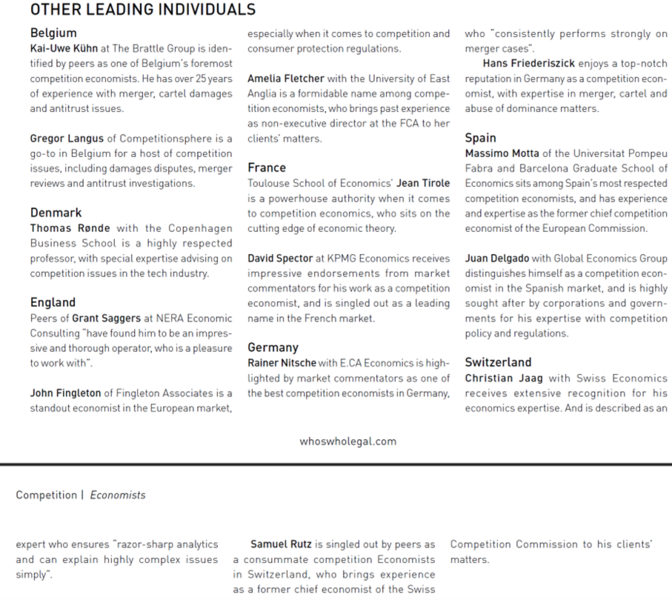
Who’s Who Legal 2020 featured Samuel Rutz, Michael Funk and Christian Jaag for their outstanding work in competition economics.
Samuel Rutz is mentioned in the following categories:
- - Competition - Economists
- - Experts - Economics - Competition Economists
WWL says: Samuel Rutz is a well-recognised figure in the Swiss market who is commended for his profound knowledge of competition regulation and policy.
Michael Funk is mentioned in the following categories:
- - Competition Future Leaders - Economists
- - Experts - Economics - Competition Economists - Future Leaders
WWL says: Michael Funk receives widespread commendations for his excellent practice, which sees him provide commercially astute analysis on competition policy issues.
Christian Jaag is mentioned in the following categories:
- - Competition - Economists
- - Experts - Economics - Competition Economists
- - Switzerland - Competition Economists
WWL says: Christian Jaag is "highly recommended" as "one of the very best competition economists in Switzerland". Peers and clients say: "Christian is brilliant at connecting academic and abstract thinking to concrete business needs."

Swiss Economics Principal Tobias Binz discusses this question in an article published in the latest issue of Competition and Regulation in Network Industries.
He uses a microeconomic framework to illustrate how firm and market characteristics determine the extent to which economy-wide demand shocks are translated into profit fluctuations. The findings may help regulators to improve the composition of the peer groups that are used to assess airports' Beta risk.
The published article can be accessed online through Competition and Regulation in Network Industries' website. A working paper version is available here.

The Fair Price Initiative aims to introduce the concept of "relative market power" to Swiss competition law. However, from an economic point of view, the concept is not an appropriate instrument to combat the high prices in Switzerland.
Read more (German)

Swiss Economics was commissioned by the Swiss State Secretariat for Economic Affairs (SECO) to conduct a meta-analysis on the effectiveness of non-pharmaceutical measures to contain the spread of the coronavirus.
On the 27th of April, two months after they were first introduced, the federal government started to relax the measures to contain the spread of the new coronavirus (SARS-CoV-2). It cannot be ruled out that this easing will lead to a renewed increase in infection rates or even a second wave of infections.
The Swiss Economics study provides an overview of available evidence on the effectiveness of various measures and indicates which measures would be particularly appropriate to implement in case infection rates start to increase again.

Swiss Economics supported the Irish Commission for Aviation Regulation in determining capital costs over the 2020-24 regulatory period. The Appeals Panel has decided in favour of the Commission of Aviation Regulation regarding appeals about capital costs.
Swiss Economics supported the Irish Commission for Aviation Regulation (CAR) in determining capital costs (WACC) over the 2020-24 regulatory period. After CAR published its projections, appeals have been made by Dublin Airport and Raynair. Among other points, the appeals targeted capital costs. An independent panel has now rejected most points of these appeals including the capital costs. CAR welcomes the decision of the panel and its argumentation. The panel stated that the numbers rely on the evaluation of the current economic conditions and conform with statutory requirements.
Press Release from the Commission for Aviation Regulation (2 June 2020)

Sunrise claims damages of CHF 350 million from Swisscom for abuse of its dominant position in the ADSL wholesale sector. Swiss Economics has supported Sunrise in quantifying the harm from the infringement.
Extract from the press release:
Swisscom abused its dominant market position from 2001 to 2007, and unlawfully hindered the competition with its pricing policy for ADSL services. The former monopolist practised a margin squeeze which made it impossible for Sunrise as a wholesale customer, to operate its ADSL business profitably.
This was confirmed by the Federal Supreme Court on December 9, 2019 after a ten-year appeal process. Swisscom was sentenced to a fine of CHF 186 million.
On the basis of this ruling, Sunrise is claiming damages of CHF 350 million plus interest from Swisscom.
Sunrise commissioned the renowned consulting company Swiss Economics to calculate the damage to Sunrise. This is due to the loss of market share and prevented gain in the broadband Internet market and adjacent markets (landline and mobile communications). The total amounts to CHF 457 million, a greater number than originally assumed. As a precautionary measure to prevent limitation, Sunrise had interrupted the statute of limitation for a claim of CHF 350 million and is filing a claim for damages of CHF 350 million plus interest with the Bern Commercial Court today.
Our team includes Christian Jaag, Michael Funk and Matthias Hafner.

The Swiss Competition Commission has approved a merger between Swiss railway company SBB Cargo and several road freight firms without imposing any remedies. Swiss Economics provided economic evidence related to efficiencies arising from the merger to inform the Commission's thinking.
The Competition Commission found that the investment of Swiss Combi (a joint venture of Planzer, Camion-Transport, Galliker, and Bertschi) in SBB Cargo does not eliminate competition in any of the concerned markets. The decision will increase the economic viability of the Swiss rail freight business and will lead to innovative new services being made available.
During Phase II of the investigation, Swiss Economics, in collaboration with SBB Cargo and law firm Walder Wyss, produced detailed economic evidence of the investment's effects on competition and welfare. The engagement was led by Samuel Rutz, Michael Funk, and Tobias Binz.

We welcome our new team member Dr. Ann-Kathrin Crede, focusing on Behavioral Economics.
Ann-Kathrin Crede works as an economist with a focus on Behavioral Economics. She graduated with her PhD in Behavioral and Experimental Economics at the University of Bern and gained experience in running laboratory and field experiments and in applying behavioural insights to organizations during her time as a research assistant.
She holds a Master’s degree in Economics from the University of Passau and a Bachelor’s degree in Business & Economics and French from the University of Kassel.
The French Autorité de régulation des transports (ART) has published its opinion on the appropriate level of the Weighted Average Cost of Capital (WACC) for Parisian airports Charles de Gaulle, Orly, and Le Bourget.
The opinion will play a central role in the negotiations between Aéroports de Paris Group and the French government regarding the Economic Regulation Agreement over the 2021-25 period.
For the assessment of Beta risk, the regulator relied on evidence provided by Swiss Economics. Our contribution was twofold. First, we analysed what drives airports’ systematic risk and defined risk categories for airports under ART’s mandate. Second, we identified valid comparator airports and determined the level of their Beta risk, using regression analysis of stock returns. Our reports on drivers of Beta risk and comparator Betas can be downloaded directly from ART’s website:

Team members of Swiss Economics awarded by Who is Who Switzerland 2020.
Christian Jaag and Samuel Rutz are highlighted for their excellent work as Competition Economists:
“At Swiss Economics, Christian Jaag has an exemplary ability ‘to convey and explain highly complex matters’ to peers and clients alike. His knowledge and skillset make him a ‘brilliant economist to work with’ and one of the leading names in Switzerland.”
“Samuel Rutz of Swiss Economics has wide-ranging knowledge and extensive experience of competition regulation and policy matters in Switzerland.”
#whoswholegal #wwl #competition

Who's Who Legal and Client Choice honoured Christian Jaag as the best Competition Economist in Switzerland in 2020.
At the inaugural Who's Who Legal Switzerland Awards ceremony on February 12, 2020, in Zurich Christian Jaag received the Competition Economist of the Year 2020 Award. Each year Who's Who Legal presents awards to individuals that have performed exceptionally well in each of the featured practice areas according to Who's Who Legal's research.
To the WWL Switzerland award winners
In addition, Christian Jaag was recently rewarded with the Lexology Client Choice award also for his work as a Competition Economist.
Established in 2005, Client Choice recognises those individuals around the world that stand apart for the excellent client care they provide and the quality of their service. The criteria for this recognition focus on the ability to add real value to clients’ businesses above and beyond the other players in the market.

The World Economic Forum (WEF) attracted not only politicians, managers and scientists to Davos but also Blockchain experts, start-ups and investors. Swiss Economics was delighted to exchange views with them.
During the World Economic Forum (WEF), the incubation space provider of the largest Swiss Blockchain Venture Capitalist, CV Labs, organized several events in Davos designed to showcase and discuss the Blockchain ecosystem. Since Christian Jaag, Matthias Hafner and Jan Christoph Schlegel are mentoring start-ups from the CV Labs incubation program, we were happy to see them pitch and progress, and to exchange views about current topics in the Blockchain ecosystem. Discussions included successful projects Swiss Economics supported in the past. CV VC proudly stated that there are now over 800 Blockchain companies in Switzerland and Lichtenstein. Swiss Economics is looking forward to new exciting collaborations in the Blockchain industry.

Swiss Economics Principal Michael Funk presents his views on the importance of economic analyses in antitrust proceedings during the “Swiss Network on Public Economics”-Workshop at ETH Zurich
At the first workshop of the "Swiss Network on Public Economics" Michael Funk presented a paper on the importance of economic analyses in antitrust proceedings. The focus was on the most recent development in Switzerland, which has resulted in the marginalisation of the economy. This development contrasts with the development in the European Union, where the negative effects of a violation of antitrust law are generally the focus of the proceedings.
The aim of the newly founded network is to strengthen relations between academics and practitioners at universities, in public administrations, the Swiss National Bank and private institutions.

Congratulations to Swiss Economics Counsel Christian Jaag for being recognized as a thought leader in the topic of competition by Who's Who Legal.


Swiss Economics supports the second incubation program of the largest investment ecosystem for start-ups using the Blockchain technology in Zug, Switzerland (CV Labs Incubation Program).
Recently, Christian Jaag and Matthias Hafner met the start-ups and presented their expertise and experience in platform and monetary economics for token-based projects. In their workshop they discussed characteristics, considerations and decisions to be made when designing token-based ecosystems.

Matthias Hafner and Nicolas Greber were awarded first and third place at BBA's 5th Scientific Conference for their research presentations.
Matthias Hafner and Nicolas Greber, two of our blockchain researchers, have made their mark at BBA's 5th Scientific Conference, with first and third place awards for their research presentations.
Matthias explained the recent depeg of the second largest stablecoin USDC and under what conditions stablecoins could lose their value. The paper and slides were created in collaboration with Marco Henriques Pereira, Juan Beccuti and Helmut Dietl.
Nicolas proposed mechanisms for handling liquidity risk using the DeFi lending platform Folks Finance. The paper and slides are the result of joint work with Matthias Hafner, Romain de Luze, Juan Becutti, Benedetto Biondi, Gidon Katten, Michelangelo Riccobene, and Alberto Arrigoni.
More about the British Blockchain Association.

Swiss Economics presents the study "Effectiveness of Corona Measures in Switzerland "
Effectiveness of Corona Measures in Switzerland
Michael Funk presented our study “Effectiveness of Corona Measures in Switzerland” at the 4th Workshop of the Swiss Network on Public Economics (SNoPE). The network aims to strengthen the ties between academics, public administration, the Swiss National Bank and private institutions such as Swiss Economics. This is exactly the intersection we address in almost all of our projects. The study provides important insights into the effectiveness of individual Corona measures in Switzerland. In addition, as the discussion at SNoPE also showed, important lessons can be learned about the opportunities and challenges of empirical evaluation for the public sector. In particular, meeting academic standards and solving non-trivial identification problems while facing time and budget constraints.

In light of the Shanghai update of the Ethereum blockchain, which allows stakers to unstake their ETH, we find it timely to investigate crypto staking in a series of upcoming blog posts.
In our first blog post, we explain the basic terms, economics and mechanisms of staking designs. Later, we compare the staking designs of seven different blockchains.
You can find the whole publication and our new Company Profile on Medium.
Don't hesitate to follow us there to stay updated on our upcoming publications!

Ramon Gmür joins the team as Economist, Romain de Luze promoted to Senior Economist.
Ramon Gmür strengthens our team as an Economist focusing on economic policy, regulatory economics and data analysis. Ramon studied economics, politics and history in his Bachelor's degree at the University of Zurich. He holds a Master’s degree in Economics and Data Science from the University of Zürich, with a special focus on Econometrics and Statistics. During his studies, he worked several years for two chairs at the University of Zurich. Prior to his studies, he worked for a major Swiss bank and earned the business title “Wirtschaftsfachmann KSZH.
Romain de Luze has been promoted to Senior Economist with a focus on regulation, data analytics and risk management. His areas of expertise include energy, financial services and cryptoassets. Additionally, Romain is involved in the development of Swiss Economics in French-speaking Switzerland and France. He holds a Master’s degree in Actuarial Science from the University of Lausanne and a Master’s degree in Economics from the University of Berne. Before Swiss Economics, he worked for several years as a quantitative analyst for a reinsurance company in Zurich.
We congratulate both of them and wish them much success and fun in their new activities for Swiss Economics.

Christian Jaag and Samuel Rutz were awarded "Leading Practitioners" by WWL in the category of Competition Economics.
Every year, Who's Who Legal identifies the world's leading competition economists. This year, Swiss Economics is represented twice - by Christian Jaag and Samuel Rutz - in the illustrious circle of "Leading Practitioners" in Europe (EMEA). We would like to thank our clients for the great trust they place in us.
WWL on Christian Jaag and Samuel Rutz:
Christian Jaag of Swiss Economics receives a lot of recognition for his economic expertise. And is described as an expert who "ensures razor-sharp analyses and can explain highly complex issues simply".
Samuel Rutz is described by peers as an outstanding competition economist in Switzerland who brings his experience as former Chief Economist of the Swiss Competition Commission to bear on the concerns of his clients.

What possibilities are there for using Blockchain Technology to make processes in the creation of value with IP more secure, transparent and efficient? A study for the Swiss Federal Institute of Intellectual Property (IPI).
Intellectual property, for example in the form of patents or copyrights, protects inventors from free riders and thus creates incentives to invest more in research and development and in creative works. IP is also relevant to the rapidly developing field of Blockchain Technology and applications. IPI would like to better assess the current and, more importantly, future demand for IP-services.
As part of this study, we are conducting a survey to which we would like to cordially invite you. The outcome of this survey will be key in shaping the IPI's services related to blockchain and IP. You can participate in the survey until October 31, 2022 over the following link: www.swiss-economics.ch/ip-survey.html.
If you are active in the field of Blockchain and/or IP, we would be delighted to incorporate your opinions, experience and expertise in this study.

We have a new Logo!
Swiss Economics has a new logo. It was designed by Diego Bally and symbolizes our abbreviation "SE". The majority of its components are pointing upwards. The logo represents our development so far and our vision for the next years. Since September, it has decorated our office windows.
The new logo will be rolled out gradually over the next weeks and months. First, we will adapt our web presence, then we will implement it in our documents.
We hope you like it!

Beatrix Marosvölgyi joined our team as an Economist. Her focus lies in environmental and political economics.
Beatrix’s expertise lies in environmental economics, regulatory impact assessments and digital markets. She completed her bachelor's degree in economics at the University of Lucerne and her master's degree at the University of Bern with a focus on environmental economics. Her master's thesis focused on the change in air pollutants due to the aircraft grounding in U.S. airspace after the 9/11 terrorist attacks.
During her studies, Beatrix worked for Swiss Post, the Universities of Lucerne and Bern, and Ernst & Young. She joined Swiss Economics in 2022 as an Analyst.
She is proficient in German and English with mother tongue Hungarian.
We wish Beatrix all the best for her future at Swiss Economics.
The Center for Cryptoeconomics partners with proof-of-stake Blockchain Algorand
Swiss Economics' Center for Cryptoeconomics (cryptecon) joins the Partner Program to intensify its services in the Algorand ecosystem. Algorand is a pure proof-of-stake blockchain focused on the convergence between decentralized and traditional finance. A perfect match for cryptecon with its strong expertise in tokenomics and protocol design for DeFi projects. Previously, cryptecon already advised several Algorand projects such as Folks Finance and Pact. We are now looking forward to intensifying our efforts on Algorand and providing our services as a Preferred Partner.
Algorand creates a green Blockchain with strong focus on efficiency and is exclusive Blockchain Partner of FIFA’s Men’s World Cup 2022 and official Sponsor of FIFA’s Women’s World Cup 2023.

More about Algorand.

We are pleased to announce that Nicolas Greber has joined the team as an Economist. His focus is on competition economics and data-driven analysis including artificial intelligence.
Nicolas Greber holds a bachelor's degree in economics with a focus on industrial economics from the University of Bern. He is currently completing his Master's degree in Economics at the University of St. Gallen with a thesis on the impact of artificial intelligence on competition.

How to design a Swiss Innovation Fund?
The Federal Council wants to strengthen Switzerland as a location for start-ups. On June 22, 2022, it made a decision in favour of a Swiss Innovation Fund. This is intended to improve the financing ecosystem of start-ups during the growth phase (to the press release).
In this context, Swiss Economics was commissioned by SECO to conduct a study on the fundamentals of such an Innovation Fund. The focus was on identifying international best practices and evaluating possible governance options for a Swiss Innovation Fund (Swiss Economics report).