News

Matthias Hafner and Nicolas Greber were awarded first and third place at BBA's 5th Scientific Conference for their research presentations.
Matthias Hafner and Nicolas Greber, two of our blockchain researchers, have made their mark at BBA's 5th Scientific Conference, with first and third place awards for their research presentations.
Matthias explained the recent depeg of the second largest stablecoin USDC and under what conditions stablecoins could lose their value. The paper and slides were created in collaboration with Marco Henriques Pereira, Juan Beccuti and Helmut Dietl.
Nicolas proposed mechanisms for handling liquidity risk using the DeFi lending platform Folks Finance. The paper and slides are the result of joint work with Matthias Hafner, Romain de Luze, Juan Becutti, Benedetto Biondi, Gidon Katten, Michelangelo Riccobene, and Alberto Arrigoni.
More about the British Blockchain Association.

Swiss Economics presents the study "Effectiveness of Corona Measures in Switzerland "
Effectiveness of Corona Measures in Switzerland
Michael Funk presented our study “Effectiveness of Corona Measures in Switzerland” at the 4th Workshop of the Swiss Network on Public Economics (SNoPE). The network aims to strengthen the ties between academics, public administration, the Swiss National Bank and private institutions such as Swiss Economics. This is exactly the intersection we address in almost all of our projects. The study provides important insights into the effectiveness of individual Corona measures in Switzerland. In addition, as the discussion at SNoPE also showed, important lessons can be learned about the opportunities and challenges of empirical evaluation for the public sector. In particular, meeting academic standards and solving non-trivial identification problems while facing time and budget constraints.

In light of the Shanghai update of the Ethereum blockchain, which allows stakers to unstake their ETH, we find it timely to investigate crypto staking in a series of upcoming blog posts.
In our first blog post, we explain the basic terms, economics and mechanisms of staking designs. Later, we compare the staking designs of seven different blockchains.
You can find the whole publication and our new Company Profile on Medium.
Don't hesitate to follow us there to stay updated on our upcoming publications!

Ramon Gmür joins the team as Economist, Romain de Luze promoted to Senior Economist.
Ramon Gmür strengthens our team as an Economist focusing on economic policy, regulatory economics and data analysis. Ramon studied economics, politics and history in his Bachelor's degree at the University of Zurich. He holds a Master’s degree in Economics and Data Science from the University of Zürich, with a special focus on Econometrics and Statistics. During his studies, he worked several years for two chairs at the University of Zurich. Prior to his studies, he worked for a major Swiss bank and earned the business title “Wirtschaftsfachmann KSZH.
Romain de Luze has been promoted to Senior Economist with a focus on regulation, data analytics and risk management. His areas of expertise include energy, financial services and cryptoassets. Additionally, Romain is involved in the development of Swiss Economics in French-speaking Switzerland and France. He holds a Master’s degree in Actuarial Science from the University of Lausanne and a Master’s degree in Economics from the University of Berne. Before Swiss Economics, he worked for several years as a quantitative analyst for a reinsurance company in Zurich.
We congratulate both of them and wish them much success and fun in their new activities for Swiss Economics.

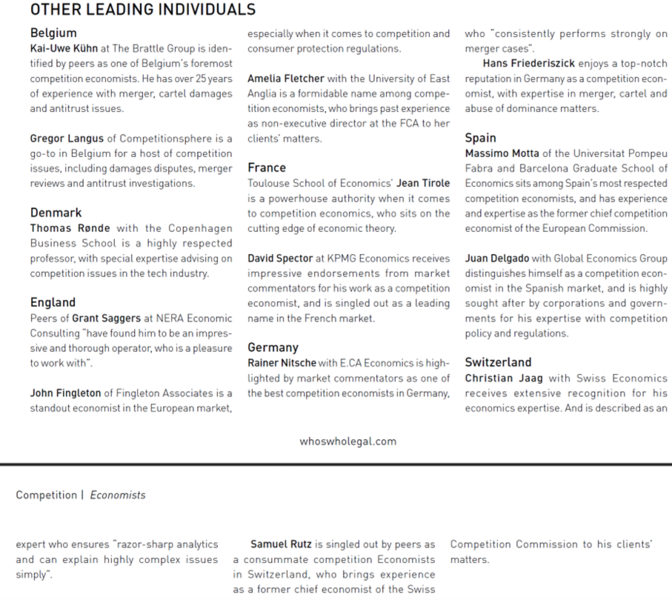
Christian Jaag and Samuel Rutz were awarded "Leading Practitioners" by WWL in the category of Competition Economics.
Every year, Who's Who Legal identifies the world's leading competition economists. This year, Swiss Economics is represented twice - by Christian Jaag and Samuel Rutz - in the illustrious circle of "Leading Practitioners" in Europe (EMEA). We would like to thank our clients for the great trust they place in us.
WWL on Christian Jaag and Samuel Rutz:
Christian Jaag of Swiss Economics receives a lot of recognition for his economic expertise. And is described as an expert who "ensures razor-sharp analyses and can explain highly complex issues simply".
Samuel Rutz is described by peers as an outstanding competition economist in Switzerland who brings his experience as former Chief Economist of the Swiss Competition Commission to bear on the concerns of his clients.

What possibilities are there for using Blockchain Technology to make processes in the creation of value with IP more secure, transparent and efficient? A study for the Swiss Federal Institute of Intellectual Property (IPI).
Intellectual property, for example in the form of patents or copyrights, protects inventors from free riders and thus creates incentives to invest more in research and development and in creative works. IP is also relevant to the rapidly developing field of Blockchain Technology and applications. IPI would like to better assess the current and, more importantly, future demand for IP-services.
As part of this study, we are conducting a survey to which we would like to cordially invite you. The outcome of this survey will be key in shaping the IPI's services related to blockchain and IP. You can participate in the survey until October 31, 2022 over the following link: www.swiss-economics.ch/ip-survey.html.
If you are active in the field of Blockchain and/or IP, we would be delighted to incorporate your opinions, experience and expertise in this study.

We have a new Logo!
Swiss Economics has a new logo. It was designed by Diego Bally and symbolizes our abbreviation "SE". The majority of its components are pointing upwards. The logo represents our development so far and our vision for the next years. Since September, it has decorated our office windows.
The new logo will be rolled out gradually over the next weeks and months. First, we will adapt our web presence, then we will implement it in our documents.
We hope you like it!

Beatrix Marosvölgyi joined our team as an Economist. Her focus lies in environmental and political economics.
Beatrix’s expertise lies in environmental economics, regulatory impact assessments and digital markets. She completed her bachelor's degree in economics at the University of Lucerne and her master's degree at the University of Bern with a focus on environmental economics. Her master's thesis focused on the change in air pollutants due to the aircraft grounding in U.S. airspace after the 9/11 terrorist attacks.
During her studies, Beatrix worked for Swiss Post, the Universities of Lucerne and Bern, and Ernst & Young. She joined Swiss Economics in 2022 as an Analyst.
She is proficient in German and English with mother tongue Hungarian.
We wish Beatrix all the best for her future at Swiss Economics.

The Center for Cryptoeconomics partners with proof-of-stake Blockchain Algorand
Swiss Economics' Center for Cryptoeconomics (cryptecon) joins the Partner Program to intensify its services in the Algorand ecosystem. Algorand is a pure proof-of-stake blockchain focused on the convergence between decentralized and traditional finance. A perfect match for cryptecon with its strong expertise in tokenomics and protocol design for DeFi projects. Previously, cryptecon already advised several Algorand projects such as Folks Finance and Pact. We are now looking forward to intensifying our efforts on Algorand and providing our services as a Preferred Partner.
Algorand creates a green Blockchain with strong focus on efficiency and is exclusive Blockchain Partner of FIFA’s Men’s World Cup 2022 and official Sponsor of FIFA’s Women’s World Cup 2023.

More about Algorand.

We are pleased to announce that Nicolas Greber has joined the team as an Economist. His focus is on competition economics and data-driven analysis including artificial intelligence.
Nicolas Greber holds a bachelor's degree in economics with a focus on industrial economics from the University of Bern. He is currently completing his Master's degree in Economics at the University of St. Gallen with a thesis on the impact of artificial intelligence on competition.

How to design a Swiss Innovation Fund?
The Federal Council wants to strengthen Switzerland as a location for start-ups. On June 22, 2022, it made a decision in favour of a Swiss Innovation Fund. This is intended to improve the financing ecosystem of start-ups during the growth phase (to the press release).
In this context, Swiss Economics was commissioned by SECO to conduct a study on the fundamentals of such an Innovation Fund. The focus was on identifying international best practices and evaluating possible governance options for a Swiss Innovation Fund (Swiss Economics report).

Swiss Economics congratulates Lilia Habibulina, Nicolas Eschenbaum and Romain de Luze on their promotions. We thank them for their support to date and wish them continued success.
Lilia Habibulina has been promoted to Senior Economist. She specialises in applying quantitative methods to regulatory questions and has extensive experience in estimating the cost of capital and in econometric modelling. Prior to joining Swiss Economics, she was a PhD candidate and postdoctoral researcher at the University of Zurich.
Nicolas Eschenbaum has been promoted to Managing Economist and has joined Swiss Economics’ executive board. He is responsible for the development and application of artificial intelligence (AI). His work focuses on competition policy as well as market regulation and market design—particularly in the context of algorithms and AI—across various sectors, including digital markets and energy. He is currently leading, among other assignments, a project for DG Comp.
Romain de Luze has also been promoted to Managing Economist and has joined Swiss Economics’ executive board. He additionally leads the Lausanne office and is responsible for business development in French-speaking Switzerland. His expertise focuses on the analysis of regulatory issues, financial modelling and strategic advisory work, particularly in the energy and transport sectors.

We would like to thank all participants and our colleague Michael Altorfer for his valuable contributions to the panel on the future of the Swiss financial market at the NextGen Impact Forum.
The forum brings together committed voices from academia, practice and politics to shape the change towards a more sustainable financial world.
Congratulations on the successful launch of the NextGen Impact Forum at the University of St. Gallen (HSG)!

You can find us at Rue du Liseron 7, 1006 Lausanne.
Since the beginning of April, you can find us at Rue du Liseron 7, in addition to our Zurich office.
This opening marks an important new milestone for us: getting closer to our partners in French-speaking Switzerland and strengthening our presence in the region. Being on site means having more opportunities to collaborate, to connect more frequently, and to support projects with even greater proximity and responsiveness.
We look forward to welcoming you there, to continuing to grow our collaborations… and to starting new ones!

Since the beginning of the year, Nina Schnyder has joined our team full-time as a Senior Economist and Michael Altorfer as an Economist. We would like to thank them for their support so far and wish them exciting projects for the future.
Michael Altorfer is joining Swiss Economics full-time after completing his studies. His focus is on energy economics, valuations and data analysis. In his Master's, he completed a double degree in economics and international management at the University of St. Gallen and the Stockholm School of Economics, with a focus on data science and climate economics.
Nina Schnyder has been with Swiss Economics since 2024 and has now been promoted to Senior Economist. Nina focuses on the areas of valuation, dispute resolution and regulatory economics, and she regularly advises and supports clients in arbitration and litigation cases and will continue working in these areas as Senior Economist. In addition, she is a CFA Level I candidate and is preparing to take her exam in February 2025.

Swiss Economics conducted a study on the federal government's ownership strategy regarding Swisscom on behalf of DETEC and the FDF.
Our report concludes that, at present, there is no sufficiently strong public interest in a federal majority stake in Swisscom—neither to ensure the provision of basic telecommunications services nor to expand a nationwide high-speed broadband network. These services are primarily provided in a competitive market or can be adequately regulated by the federal government through legislation. However, given the reassessment of the security implications of telecommunications and information infrastructure, there may be a public interest in federal government ownership of a stake in Swisscom. Since legislation and commercial contracts can only partially regulate the provision of the necessary services, having ultimate control through ownership in this sensitive sector may be advisable.
However, government activity in competitive markets generally leads to distortions of competition. Even a strict separation of the ownership role from supervisory and regulatory functions cannot fully resolve the fundamental conflict of objectives between the economic interest in effective competition and the fiscal interest in dividend income. The balance between the public interest in a majority stake and competitive neutrality is ultimately a political question that this report cannot definitively answer. With regard to the formulation of strategic objectives, we recommend explicitly mentioning the public interest in Swisscom’s security policy responsibilities.
In addition to a majority stake and a complete sale, we also examined alternative courses of action, such as the establishment of a state-owned network company or the retention of a blocking minority. However, no additional benefits were identified.
The evaluation was conducted in collaboration with Martina Arioli and Lukas Bruhin of Arioli Law.
Michael Funk, Urs Trinkner, Lukas Bruhin, Martina Arioli, Nicolas Oderbolz, Nina Schnyder
To the Federal Council’s press release

We are delighted to welcome Dr Marco Salvi and Bastian Seiler as new members of staff. They will strengthen the Swiss Economics team in the area of economic policy and energy.
Bastian Seiler joins the Swiss Economics team as Senior Economist. He studied political science, economics and economic and social history at the University of Zurich. After his studies, he gained over 10 years of professional experience in different roles across the energy and infrastructure industry. At Swiss Economics, he will primarily work as a consultant and project manager in the areas of energy, finance and insurance, as well as regulation and risk management.
Dr. Marco Salvi joins Swiss Economics as Managing Economist. He holds a PhD from EPFL and brings over 10 years of experience in economic policy analysis. As a Senior Fellow at Avenir Suisse, he was responsible for labor market, social, and housing policy and played a key role in shaping the think tank’s strategic direction. Previously, he served as a project leader focusing on tax and fiscal policy. Before joining Avenir Suisse in 2011, he led three specialist teams at Zürcher Kantonalbank, where he developed innovative risk models for the real estate and mortgage markets. He is an Adjunct Fellow at Avenir Suisse and lectures on Real Estate Finance at the University of Zurich.
At Swiss Economics, he will be responsible for topics such as real estate economics, regional economics, and labor market issues.

Swiss Economics examined the role of temporary work from an economic perspective and assessed the potential impact of current regulatory proposals on the labor market for swissstaffing.
Several proposals for additional regulation of temporary agency work are currently under discussion. Our study, conducted on behalf of swissstaffing, concludes that these proposals do not bring any added value. The analysis, which was carried out using the regulatory impact assessment (RIA) method, shows that temporary work plays an important role in the labour market. It reduces market frictions and enables efficient and rapid placement between companies and employees.
Temporary agency work thus provides flexibility, but at the same time is in tension with employment security. Without temporary agency work, an increase in less regulated forms of work such as temporary employment, self-employment or on-demand work could be expected. Unemployment and undeclared work could also increase. Moreover, temporary agency workers in Switzerland already benefit from comprehensive protection through a collective labour agreement.

Swiss Economics supported UBS in its merger with CS in the FINMA control procedure.
On June 19, 2024, the Swiss Financial Market Supervisory Authority FINMA announced that it had concluded the antitrust review procedure for the merger between UBS and Credit Suisse without imposing any conditions or obligations. Following an extensive review, it concluded that the merger would not eliminate effective competition in any market segment.
Swiss Economics supported UBS in these proceedings with two economic expert opinions and the compilation of market data. The first report contained a comprehensive analysis of the competitive situation on all relevant banking markets. The second report provided a more in-depth analysis of individual segments that were the focus of the Competition Commission's statement to FINMA. The Swiss Economics team, consisting of Dr. Michael Funk, Dr. Samuel Rutz, Dr. Eva Zuberbühler and Seline Spillmann, worked closely with the antitrust team of Bär & Karrer, represented by Dr. Mani Reinert and Dr. Christine Schweikard.

Supporting low-income households directly or providing subsidized housing? Swiss Economics analyses the affordability of housing costs and housing policy instruments to relieve the burden on households in Switzerland.
Our latest study, which we carried out on behalf of the Verband Immobilien Schweiz (VIS), shows which households may have financial problems with housing costs. The salient features of these households are:
single - settled in a moderately populated region - tend to consume a lot of living space per person - low-income.
In order to relieve the burden on households, the state has two social policy instruments at its disposal: supply-side and demand-side subsidies. The former subsidises housing directly, while the latter supports households with housing allowances. Supply-side subsidy is mainly realised through the housing stock of cities and municipalities, while demand-side subsidy support is primarily provided via social welfare and AHV/IV supplementary benefits. Our calculations show that the public sector currently spends roughly the same amount per supported household on subsidised housing as on housing allowances: on average around CHF 5,000 per year. However, housing allowances are more targeted, as it almost exclusively benefits households in need.
Based on the demand-side subsidy systems currently in place in Switzerland, we estimate the costs of extending these systems to all overburdened households. This shows that in an expanded system of demand-side support, around 50 per cent more low-income households could be supported with the funds currently used for supply-side support than is currently the case.