News

Matthias Hafner and Nicolas Greber were awarded first and third place at BBA's 5th Scientific Conference for their research presentations.
Matthias Hafner and Nicolas Greber, two of our blockchain researchers, have made their mark at BBA's 5th Scientific Conference, with first and third place awards for their research presentations.
Matthias explained the recent depeg of the second largest stablecoin USDC and under what conditions stablecoins could lose their value. The paper and slides were created in collaboration with Marco Henriques Pereira, Juan Beccuti and Helmut Dietl.
Nicolas proposed mechanisms for handling liquidity risk using the DeFi lending platform Folks Finance. The paper and slides are the result of joint work with Matthias Hafner, Romain de Luze, Juan Becutti, Benedetto Biondi, Gidon Katten, Michelangelo Riccobene, and Alberto Arrigoni.
More about the British Blockchain Association.

Swiss Economics presents the study "Effectiveness of Corona Measures in Switzerland "
Effectiveness of Corona Measures in Switzerland
Michael Funk presented our study “Effectiveness of Corona Measures in Switzerland” at the 4th Workshop of the Swiss Network on Public Economics (SNoPE). The network aims to strengthen the ties between academics, public administration, the Swiss National Bank and private institutions such as Swiss Economics. This is exactly the intersection we address in almost all of our projects. The study provides important insights into the effectiveness of individual Corona measures in Switzerland. In addition, as the discussion at SNoPE also showed, important lessons can be learned about the opportunities and challenges of empirical evaluation for the public sector. In particular, meeting academic standards and solving non-trivial identification problems while facing time and budget constraints.

In light of the Shanghai update of the Ethereum blockchain, which allows stakers to unstake their ETH, we find it timely to investigate crypto staking in a series of upcoming blog posts.
In our first blog post, we explain the basic terms, economics and mechanisms of staking designs. Later, we compare the staking designs of seven different blockchains.
You can find the whole publication and our new Company Profile on Medium.
Don't hesitate to follow us there to stay updated on our upcoming publications!

Ramon Gmür joins the team as Economist, Romain de Luze promoted to Senior Economist.
Ramon Gmür strengthens our team as an Economist focusing on economic policy, regulatory economics and data analysis. Ramon studied economics, politics and history in his Bachelor's degree at the University of Zurich. He holds a Master’s degree in Economics and Data Science from the University of Zürich, with a special focus on Econometrics and Statistics. During his studies, he worked several years for two chairs at the University of Zurich. Prior to his studies, he worked for a major Swiss bank and earned the business title “Wirtschaftsfachmann KSZH.
Romain de Luze has been promoted to Senior Economist with a focus on regulation, data analytics and risk management. His areas of expertise include energy, financial services and cryptoassets. Additionally, Romain is involved in the development of Swiss Economics in French-speaking Switzerland and France. He holds a Master’s degree in Actuarial Science from the University of Lausanne and a Master’s degree in Economics from the University of Berne. Before Swiss Economics, he worked for several years as a quantitative analyst for a reinsurance company in Zurich.
We congratulate both of them and wish them much success and fun in their new activities for Swiss Economics.

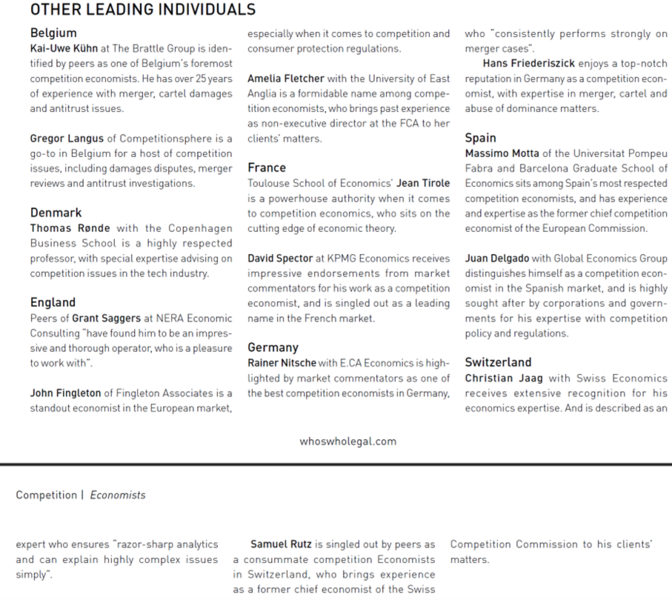
Christian Jaag and Samuel Rutz were awarded "Leading Practitioners" by WWL in the category of Competition Economics.
Every year, Who's Who Legal identifies the world's leading competition economists. This year, Swiss Economics is represented twice - by Christian Jaag and Samuel Rutz - in the illustrious circle of "Leading Practitioners" in Europe (EMEA). We would like to thank our clients for the great trust they place in us.
WWL on Christian Jaag and Samuel Rutz:
Christian Jaag of Swiss Economics receives a lot of recognition for his economic expertise. And is described as an expert who "ensures razor-sharp analyses and can explain highly complex issues simply".
Samuel Rutz is described by peers as an outstanding competition economist in Switzerland who brings his experience as former Chief Economist of the Swiss Competition Commission to bear on the concerns of his clients.

What possibilities are there for using Blockchain Technology to make processes in the creation of value with IP more secure, transparent and efficient? A study for the Swiss Federal Institute of Intellectual Property (IPI).
Intellectual property, for example in the form of patents or copyrights, protects inventors from free riders and thus creates incentives to invest more in research and development and in creative works. IP is also relevant to the rapidly developing field of Blockchain Technology and applications. IPI would like to better assess the current and, more importantly, future demand for IP-services.
As part of this study, we are conducting a survey to which we would like to cordially invite you. The outcome of this survey will be key in shaping the IPI's services related to blockchain and IP. You can participate in the survey until October 31, 2022 over the following link: www.swiss-economics.ch/ip-survey.html.
If you are active in the field of Blockchain and/or IP, we would be delighted to incorporate your opinions, experience and expertise in this study.

We have a new Logo!
Swiss Economics has a new logo. It was designed by Diego Bally and symbolizes our abbreviation "SE". The majority of its components are pointing upwards. The logo represents our development so far and our vision for the next years. Since September, it has decorated our office windows.
The new logo will be rolled out gradually over the next weeks and months. First, we will adapt our web presence, then we will implement it in our documents.
We hope you like it!

Beatrix Marosvölgyi joined our team as an Economist. Her focus lies in environmental and political economics.
Beatrix’s expertise lies in environmental economics, regulatory impact assessments and digital markets. She completed her bachelor's degree in economics at the University of Lucerne and her master's degree at the University of Bern with a focus on environmental economics. Her master's thesis focused on the change in air pollutants due to the aircraft grounding in U.S. airspace after the 9/11 terrorist attacks.
During her studies, Beatrix worked for Swiss Post, the Universities of Lucerne and Bern, and Ernst & Young. She joined Swiss Economics in 2022 as an Analyst.
She is proficient in German and English with mother tongue Hungarian.
We wish Beatrix all the best for her future at Swiss Economics.

The Center for Cryptoeconomics partners with proof-of-stake Blockchain Algorand
Swiss Economics' Center for Cryptoeconomics (cryptecon) joins the Partner Program to intensify its services in the Algorand ecosystem. Algorand is a pure proof-of-stake blockchain focused on the convergence between decentralized and traditional finance. A perfect match for cryptecon with its strong expertise in tokenomics and protocol design for DeFi projects. Previously, cryptecon already advised several Algorand projects such as Folks Finance and Pact. We are now looking forward to intensifying our efforts on Algorand and providing our services as a Preferred Partner.
Algorand creates a green Blockchain with strong focus on efficiency and is exclusive Blockchain Partner of FIFA’s Men’s World Cup 2022 and official Sponsor of FIFA’s Women’s World Cup 2023.

More about Algorand.

We are pleased to announce that Nicolas Greber has joined the team as an Economist. His focus is on competition economics and data-driven analysis including artificial intelligence.
Nicolas Greber holds a bachelor's degree in economics with a focus on industrial economics from the University of Bern. He is currently completing his Master's degree in Economics at the University of St. Gallen with a thesis on the impact of artificial intelligence on competition.

How to design a Swiss Innovation Fund?
The Federal Council wants to strengthen Switzerland as a location for start-ups. On June 22, 2022, it made a decision in favour of a Swiss Innovation Fund. This is intended to improve the financing ecosystem of start-ups during the growth phase (to the press release).
In this context, Swiss Economics was commissioned by SECO to conduct a study on the fundamentals of such an Innovation Fund. The focus was on identifying international best practices and evaluating possible governance options for a Swiss Innovation Fund (Swiss Economics report).

Presentation on postal strategies in a digital age.
Christian Jaag presented a paper on "Postal Strategies in a Digital age" at the 4th Conference on the Regulation of Infrastructures of the Florence School of Regulation.

Multiple papers presented in Athens.
Swiss Economics contributed three presentations and papers to the 23rd Conference on Postal and Delivery Economics:
- Commercial and regulatory challenges for postal e-services in Switzerland
- Cryptocurrencies: New Opportunities for Postal Financial Services
- Postal strategies in a digital age
All papers are available in our Working Paper Series.

A contribution of Swiss Economics team members has been published in the journal for Competition and Regulation in Network Industries.
Abstract: Rail passenger transport services with integrated regular interval timetables (IRIT) offer passengers a regular interval timetable for services on the railway network. IRIT have the potential to increase the quality and attractiveness of railway passenger services in comparison to other transport modes. This paper summarizes the advantages and challenges of the implementation of IRIT for railway passenger services, presents a quantitative model which simulates passenger utility in an IRIT railway system compared to other forms of timetables, and derives the main requirements for the successful introduction of IRIT. The comparison of the regulatory framework, the role of IRIT and the development of passenger railway services in CH, the NL and the UK, shows that in those countries where either IRIT has been introduced (CH) or the high frequency of trains between cities provides for a system comparable to IRIT (NL), railway services play a more important role in the modal split. The successful introduction of IRIT requires a long-run implementation schedule which identifies the necessary investment in the railway infrastructure and points out the financial resources available to make those investments. Further, IRIT requires a high level of punctuality of railway passenger services, coordination between railway companies when designing the timetable and a priority rule for passenger railway services within IRIT when there are capacity restrictions on the railway network.

A study for Bundesamt für Energie (BFE).
The Swiss Federal Office of Energy (SFOE) published a report of Ecofys and Swiss Economics on future energy markets and the role of power network operators.

A collaboration with the University of Zurich.

Article on the experiences with the electricity market opening in the EU.
In a recent article on the experiences with the electricity market in the EU, we conclude that the member states have not yet worked out a silver bullet in the organization of the regulatory conditions.

Two new publications on the postal market in Switzerland and in the United States.

Swiss Economics welcomes Dr. Michael Funk as a new staff member!
Dr. Michael Funk is a project leader for Swiss Economics with a focus on competition policy and regulatory economics. After his studies in history and economics at the University of Fribourg, he obtained his Doctorate in the areas of political economics and financial sciences. He subsequently worked as an economist for the competition commission.

Presentation at the International Postal and e-Communications Conference on the Swiss regulatory framework for the postal sector in light of current challenges.
At the International Postal and e-Communications Conference, Christian Jaag gave a presentation on the Swiss regulatory framework for the postal sector in light of current challenges.

Dr. Martin Lutzenberger appointed Director Berlin Office.
Martin Lutzenberger is our new Director of Office Berlin. Focusing on competition economics, economic policy, transportation and energy, Martin will develop our activities in Germany.
After his studies in economics at the University of Freiburg i.Br. he received a doctoral degree at the University of Zurich. From 2010 to 2014, he was a project manager and lecturer at the University of Lucerne. Besides, he was a lecturer at the University of Zurich and an external expert in Swiss Economics.

Recent conference contributions are available in our working paper series.
Swiss Economics has presented recent research papers at the 22th Conference on Postal and Delivery Economics:
- USO cost allocation rules and welfare
- Market Regulations and USO in the Revised Swiss Postal Act
- Estimating the Financial Impact of Discontinuing Saturday Delivery
The works are available in our Working Paper Series.

We accept payments and offer to pay salaries in Bitcoin.
As of now, we accept Bitcoin as payment for our consulting services. We also offer our employees the option to receive their salary (or a part of it) in Bitcoin.

A report for the United States Postal Regulatory Commission.
The U.S. Postal Regulatory Commission (PRC) published today a report of Swiss Economics on the Impact of the discontinuance of Saturday delivery for letters and flats on the U.S. Postal Service.
Presentation of the research paper on «The Effect of Payment Reversibility on E-commerce and Postal Quality».
Christian Jaag presented the research paper «The Effect of Payment Reversibility on E-commerce and Postal Quality» at the 8th Bi-Annual Postal Economics Conference of the Toulouse School of Economics. The irreversibility of payments in virtual currencies shifts the risk of e-commerce from merchants to consumers. Under certain conditions, this strengthens online retailers in competition with brick-and-mortar stores as well as incentives for postal quality.

A report for Bundesnetzagentur.
BNetzA published the report of Swiss Economics on benchmarking the German energy distribution system operators.
New publications on assessing the burden of universal service providers and on calculating the net costs of home delivery obligations.
Two new publications of Swiss Economics team members have been published in the book «The Role of the Postal and Delivery Sector in a Digital Age».
To the book
To the working paper «USO Burden»
To the working paper «USO Delivery»

Contribution to the webinar on “Virtual currencies: Exploring a Potential Role for Postal Operators».
The webinar included inputs from the USPS IOG Global Team and the UPU