News

Matthias Hafner and Nicolas Greber were awarded first and third place at BBA's 5th Scientific Conference for their research presentations.
Matthias Hafner and Nicolas Greber, two of our blockchain researchers, have made their mark at BBA's 5th Scientific Conference, with first and third place awards for their research presentations.
Matthias explained the recent depeg of the second largest stablecoin USDC and under what conditions stablecoins could lose their value. The paper and slides were created in collaboration with Marco Henriques Pereira, Juan Beccuti and Helmut Dietl.
Nicolas proposed mechanisms for handling liquidity risk using the DeFi lending platform Folks Finance. The paper and slides are the result of joint work with Matthias Hafner, Romain de Luze, Juan Becutti, Benedetto Biondi, Gidon Katten, Michelangelo Riccobene, and Alberto Arrigoni.
More about the British Blockchain Association.

Swiss Economics presents the study "Effectiveness of Corona Measures in Switzerland "
Effectiveness of Corona Measures in Switzerland
Michael Funk presented our study “Effectiveness of Corona Measures in Switzerland” at the 4th Workshop of the Swiss Network on Public Economics (SNoPE). The network aims to strengthen the ties between academics, public administration, the Swiss National Bank and private institutions such as Swiss Economics. This is exactly the intersection we address in almost all of our projects. The study provides important insights into the effectiveness of individual Corona measures in Switzerland. In addition, as the discussion at SNoPE also showed, important lessons can be learned about the opportunities and challenges of empirical evaluation for the public sector. In particular, meeting academic standards and solving non-trivial identification problems while facing time and budget constraints.

In light of the Shanghai update of the Ethereum blockchain, which allows stakers to unstake their ETH, we find it timely to investigate crypto staking in a series of upcoming blog posts.
In our first blog post, we explain the basic terms, economics and mechanisms of staking designs. Later, we compare the staking designs of seven different blockchains.
You can find the whole publication and our new Company Profile on Medium.
Don't hesitate to follow us there to stay updated on our upcoming publications!

Ramon Gmür joins the team as Economist, Romain de Luze promoted to Senior Economist.
Ramon Gmür strengthens our team as an Economist focusing on economic policy, regulatory economics and data analysis. Ramon studied economics, politics and history in his Bachelor's degree at the University of Zurich. He holds a Master’s degree in Economics and Data Science from the University of Zürich, with a special focus on Econometrics and Statistics. During his studies, he worked several years for two chairs at the University of Zurich. Prior to his studies, he worked for a major Swiss bank and earned the business title “Wirtschaftsfachmann KSZH.
Romain de Luze has been promoted to Senior Economist with a focus on regulation, data analytics and risk management. His areas of expertise include energy, financial services and cryptoassets. Additionally, Romain is involved in the development of Swiss Economics in French-speaking Switzerland and France. He holds a Master’s degree in Actuarial Science from the University of Lausanne and a Master’s degree in Economics from the University of Berne. Before Swiss Economics, he worked for several years as a quantitative analyst for a reinsurance company in Zurich.
We congratulate both of them and wish them much success and fun in their new activities for Swiss Economics.

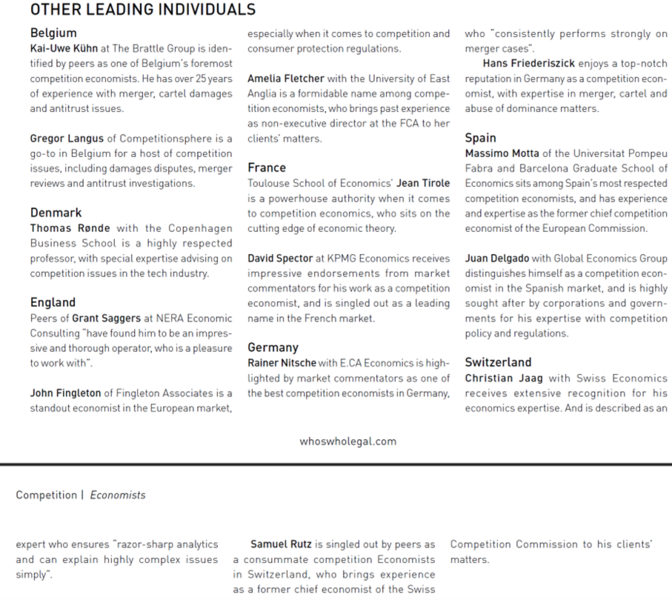
Christian Jaag and Samuel Rutz were awarded "Leading Practitioners" by WWL in the category of Competition Economics.
Every year, Who's Who Legal identifies the world's leading competition economists. This year, Swiss Economics is represented twice - by Christian Jaag and Samuel Rutz - in the illustrious circle of "Leading Practitioners" in Europe (EMEA). We would like to thank our clients for the great trust they place in us.
WWL on Christian Jaag and Samuel Rutz:
Christian Jaag of Swiss Economics receives a lot of recognition for his economic expertise. And is described as an expert who "ensures razor-sharp analyses and can explain highly complex issues simply".
Samuel Rutz is described by peers as an outstanding competition economist in Switzerland who brings his experience as former Chief Economist of the Swiss Competition Commission to bear on the concerns of his clients.

What possibilities are there for using Blockchain Technology to make processes in the creation of value with IP more secure, transparent and efficient? A study for the Swiss Federal Institute of Intellectual Property (IPI).
Intellectual property, for example in the form of patents or copyrights, protects inventors from free riders and thus creates incentives to invest more in research and development and in creative works. IP is also relevant to the rapidly developing field of Blockchain Technology and applications. IPI would like to better assess the current and, more importantly, future demand for IP-services.
As part of this study, we are conducting a survey to which we would like to cordially invite you. The outcome of this survey will be key in shaping the IPI's services related to blockchain and IP. You can participate in the survey until October 31, 2022 over the following link: www.swiss-economics.ch/ip-survey.html.
If you are active in the field of Blockchain and/or IP, we would be delighted to incorporate your opinions, experience and expertise in this study.

We have a new Logo!
Swiss Economics has a new logo. It was designed by Diego Bally and symbolizes our abbreviation "SE". The majority of its components are pointing upwards. The logo represents our development so far and our vision for the next years. Since September, it has decorated our office windows.
The new logo will be rolled out gradually over the next weeks and months. First, we will adapt our web presence, then we will implement it in our documents.
We hope you like it!

Beatrix Marosvölgyi joined our team as an Economist. Her focus lies in environmental and political economics.
Beatrix’s expertise lies in environmental economics, regulatory impact assessments and digital markets. She completed her bachelor's degree in economics at the University of Lucerne and her master's degree at the University of Bern with a focus on environmental economics. Her master's thesis focused on the change in air pollutants due to the aircraft grounding in U.S. airspace after the 9/11 terrorist attacks.
During her studies, Beatrix worked for Swiss Post, the Universities of Lucerne and Bern, and Ernst & Young. She joined Swiss Economics in 2022 as an Analyst.
She is proficient in German and English with mother tongue Hungarian.
We wish Beatrix all the best for her future at Swiss Economics.

The Center for Cryptoeconomics partners with proof-of-stake Blockchain Algorand
Swiss Economics' Center for Cryptoeconomics (cryptecon) joins the Partner Program to intensify its services in the Algorand ecosystem. Algorand is a pure proof-of-stake blockchain focused on the convergence between decentralized and traditional finance. A perfect match for cryptecon with its strong expertise in tokenomics and protocol design for DeFi projects. Previously, cryptecon already advised several Algorand projects such as Folks Finance and Pact. We are now looking forward to intensifying our efforts on Algorand and providing our services as a Preferred Partner.
Algorand creates a green Blockchain with strong focus on efficiency and is exclusive Blockchain Partner of FIFA’s Men’s World Cup 2022 and official Sponsor of FIFA’s Women’s World Cup 2023.

More about Algorand.

We are pleased to announce that Nicolas Greber has joined the team as an Economist. His focus is on competition economics and data-driven analysis including artificial intelligence.
Nicolas Greber holds a bachelor's degree in economics with a focus on industrial economics from the University of Bern. He is currently completing his Master's degree in Economics at the University of St. Gallen with a thesis on the impact of artificial intelligence on competition.

How to design a Swiss Innovation Fund?
The Federal Council wants to strengthen Switzerland as a location for start-ups. On June 22, 2022, it made a decision in favour of a Swiss Innovation Fund. This is intended to improve the financing ecosystem of start-ups during the growth phase (to the press release).
In this context, Swiss Economics was commissioned by SECO to conduct a study on the fundamentals of such an Innovation Fund. The focus was on identifying international best practices and evaluating possible governance options for a Swiss Innovation Fund (Swiss Economics report).

On behalf of the State Secretariat for Economic Affairs (SECO), Swiss Economics has updated its findings on the effectiveness of non-pharmaceutical measures to combat the pandemic.
Swiss Economics has examined the effectiveness of non-pharmaceutical interventions ("NPI") to contain the coronavirus (to the Swiss Economics study) for a second time. This is an update of the meta-analysis on this topic commissioned by the State Secretariat for Economic Affairs (SECO) in June 2020. In addition to the question of the effectiveness of NPI, the study also evaluates the literature on the costs of particular measures and discusses the findings on factors such as the weather and the acceptance of NPI among the population. In the course of combating the pandemic, the question of the optimal level of intervention also arose in Switzerland. Another part of the study is devoted to this question.

Felix Wüthrich and Luca Apreda now Economist, Eva Zuberbühler und Nicolas Eschenbaum now Senior Economist
We are expanding our team:
Felix Wüthrich strengthens our team as an Economist in the areas of environmental economics, behavioural economics and data analysis. During his studies at ETH Zurich, Felix already completed an internship at Swiss Economics and subsequently supported our team as an Analyst.
Luca Apreda, now also Economist, has a focus on regulation and quantitative methods. After completing his Master's degree at the University of Bern, Luca joined Swiss Economics as an Analyst.
Dr. Eva Zuberbühler has been promoted to Senior Economist. Her expertise lies in the areas of regulation, competition, strategy and pricing. Prior to completing her PhD in industrial economics at the University of Bern, Eva worked as a corporate client advisor at a major bank
Dr. Nicolas Eschenbaum has also been promoted to Senior Economist. He focuses on competition economics and digital markets. Nicolas received his PhD in industrial economics from the University of St. Gallen and conducted postdoctoral research on the competitive impact of artificial intelligence, among other topics.
We congratulate all four and wish them much success and joy in their further work for Swiss Economics.

Michael Funk was asked about the consquences of the EU Digital Markets Act (DMA) and Digital Services Act (DSA) by SRF's daily podcast "Newsplus".
The EU is working to improve the current regulatory framework for digital products. The introduction of the Digital Markets Act (DMA) and the Digital Services Act (DSA) is intended to create a uniform set of rules valid throughout the EU.
Michael Funk was asked by SRF about the consequences of the extensive package for Switzerland.
To the podcast (in German): https://www.srf.ch/audio/news-plus/eine-neue-aera-fuer-internet-giganten?id=12166241

We are pleased to welcome Dr. Nicolas Eschenbaum as a new team member of Swiss Economics. He will strengthen our competences in competition economics and regulation.
Nicolas Eschenbaum is an experienced economist focusing on competition economics and economics of digitization.
He holds a Ph.D. in Economics and Finance from the University of St. Gallen with a thesis in industrial organization with a focus on digital markets. Prior to joining Swiss Economics, Nicolas worked as a postdoctoral researcher at the University of St. Gallen, where he continues to conduct research and teach. Currently, his research focuses on the intersection of game theory and artificial intelligence.

We are pleased to announce that Matteo Mattmann has been appointed Managing Economist as of January 1.
We welcome Matteo Mattmann among the shareholders of Swiss Economics. As a member of the Management Board, he will develop our activities in health and behavioural economics. We wish him every success in his new position and look forward to thee continuing collaboration.

Since January 2021, Swiss Economics is a carbon neutral company. Swiss Economics minimizes greenhouse gas emissions and offsets emissions that cannot be avoided.
The exact principles with which we try to contribute to the achievement of Switzerland's climate goals can be found here.
For the year 2021, our employees have decided to offset by means of a reforestation project in Nicaragua. The offset is certified by myclimate.

The modernisation of Swiss merger control is the core element of the partial revision of the Cartel Act (KG). With its 2017 study about the SIEC test, Swiss Economics made an important contribution to the revision.
The partial revision of the KG envisages adapting the Swiss test for merger control to international practice. The fundamental difference between the market dominance test applied in Switzerland so far and the newly envisaged SIEC test lies in the level of the intervention hurdle. Under the SIEC test, mergers can be prohibited or subject to appropriate conditions if they lead to a "significant" impediment to competition. In contrast, under the current standard of review, this is only possible if a merger "completely" eliminates effective competition. In addition, the planned revision also aims to strengthen private damages actions and provides for several procedural changes as well as a clarification with regard to inadmissible agreements.
The consultation period lasts until 11 March 2022. It can be assumed that the new provisions will not enter into force before 2023/24.

Malou and Valpuri had the opportunity to spend the "Future Day" at Swiss Economics.
Highlights of their day in our office were conducting interviews and editing them into a video, behavioural economics experiments with a chocolate reward and eating pizza in the park. The thoughts of the two primary school students of their fathers' work are in the video below.

Ann-Kathrin Crede participated in the SRF programme "Club" on the topic of National Immunisation Week and contributed with her behavioural economics expertise to the question of how to incentivize people to vaccinate themselves.
Quelle: srf.ch

Swiss Economics/cryptecon continue to support the CV Labs Incubation Program for start-ups using the Blockchain technology.
Recently, Juan Beccuti joined CV Labs as a mentor for the start-ups' incubation program. Together with Matthias Hafner (who joined CV Labs in 2019), he shares his expertise in platform and token economics. They present and discuss with the program's participants the main characteristics, considerations, and decisions to consider when designing token-based ecosystems.

Presentation of the interim report in the project to hedge terror and pandemic risks at the Federal Ministry of Finance in Berlin.
Swiss Economics, presented together with Christian Hott (from Economic Advice) the first results in the project on hedging terror and pandemic risks at the Federal Ministry of Finance in Berlin.

Lilia is a quantitative economist strengthening our competencies in analyzing panel and time-series data. Lilia is proficient in English and German with mother tongue Russian.
Dr. Lilia Ruslanova is a quantiative economist focusing on empirical methods, econometrics and DCF modelling. She holds a PhD in Economics from the University of Zurich. During her work as a doctoral student as well as research associate at the University of Zurich, she accumulated years of proficient experience in processing and analyzing data using various quantitative methods and statistical tools. The main fields of her research interests are International Macroeconomics, International Trade, Financial Regulation, Financial and Real Estate Markets.

Juan is a microeconomist and industrial engineer with a focus on market design. He will support Swiss Economics in platform and crypto economics.
Juan is an experienced economist focusing on platform economics, contract theory, and auctions. Amongst others, he will support our team in the analysis of incentives in crypto markets and blockchain protocols. Juan's mother tongue is Spanish, extending our reach into the Hispanic region.
Juan holds a Ph.D. in Economics from Universidad Carlos III de Madrid with a dissertation about mechanism design. He also has a degree in industrial engineering. Prior to joining Swiss Economics full-time, Juan supported Swiss Economics as a Senior Fellow and worked as a Postdoctoral Associate at the University of Bern.