News

Matthias Hafner and Nicolas Greber were awarded first and third place at BBA's 5th Scientific Conference for their research presentations.
Matthias Hafner and Nicolas Greber, two of our blockchain researchers, have made their mark at BBA's 5th Scientific Conference, with first and third place awards for their research presentations.
Matthias explained the recent depeg of the second largest stablecoin USDC and under what conditions stablecoins could lose their value. The paper and slides were created in collaboration with Marco Henriques Pereira, Juan Beccuti and Helmut Dietl.
Nicolas proposed mechanisms for handling liquidity risk using the DeFi lending platform Folks Finance. The paper and slides are the result of joint work with Matthias Hafner, Romain de Luze, Juan Becutti, Benedetto Biondi, Gidon Katten, Michelangelo Riccobene, and Alberto Arrigoni.
More about the British Blockchain Association.

Swiss Economics presents the study "Effectiveness of Corona Measures in Switzerland "
Effectiveness of Corona Measures in Switzerland
Michael Funk presented our study “Effectiveness of Corona Measures in Switzerland” at the 4th Workshop of the Swiss Network on Public Economics (SNoPE). The network aims to strengthen the ties between academics, public administration, the Swiss National Bank and private institutions such as Swiss Economics. This is exactly the intersection we address in almost all of our projects. The study provides important insights into the effectiveness of individual Corona measures in Switzerland. In addition, as the discussion at SNoPE also showed, important lessons can be learned about the opportunities and challenges of empirical evaluation for the public sector. In particular, meeting academic standards and solving non-trivial identification problems while facing time and budget constraints.

In light of the Shanghai update of the Ethereum blockchain, which allows stakers to unstake their ETH, we find it timely to investigate crypto staking in a series of upcoming blog posts.
In our first blog post, we explain the basic terms, economics and mechanisms of staking designs. Later, we compare the staking designs of seven different blockchains.
You can find the whole publication and our new Company Profile on Medium.
Don't hesitate to follow us there to stay updated on our upcoming publications!

Ramon Gmür joins the team as Economist, Romain de Luze promoted to Senior Economist.
Ramon Gmür strengthens our team as an Economist focusing on economic policy, regulatory economics and data analysis. Ramon studied economics, politics and history in his Bachelor's degree at the University of Zurich. He holds a Master’s degree in Economics and Data Science from the University of Zürich, with a special focus on Econometrics and Statistics. During his studies, he worked several years for two chairs at the University of Zurich. Prior to his studies, he worked for a major Swiss bank and earned the business title “Wirtschaftsfachmann KSZH.
Romain de Luze has been promoted to Senior Economist with a focus on regulation, data analytics and risk management. His areas of expertise include energy, financial services and cryptoassets. Additionally, Romain is involved in the development of Swiss Economics in French-speaking Switzerland and France. He holds a Master’s degree in Actuarial Science from the University of Lausanne and a Master’s degree in Economics from the University of Berne. Before Swiss Economics, he worked for several years as a quantitative analyst for a reinsurance company in Zurich.
We congratulate both of them and wish them much success and fun in their new activities for Swiss Economics.

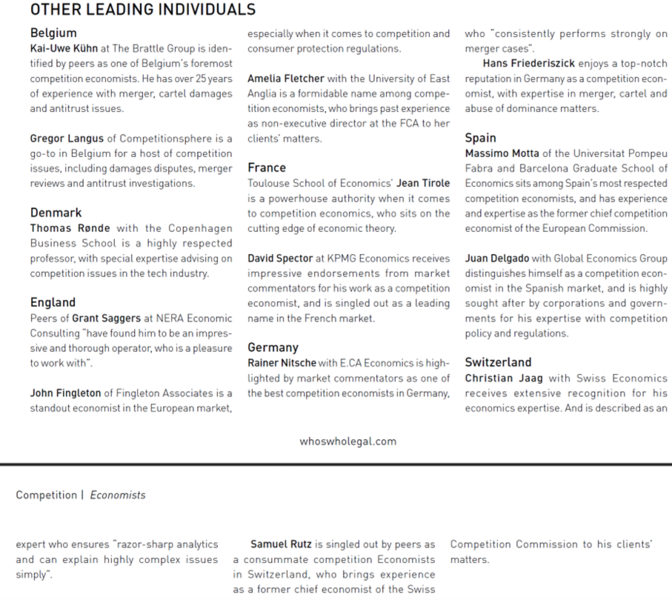
Christian Jaag and Samuel Rutz were awarded "Leading Practitioners" by WWL in the category of Competition Economics.
Every year, Who's Who Legal identifies the world's leading competition economists. This year, Swiss Economics is represented twice - by Christian Jaag and Samuel Rutz - in the illustrious circle of "Leading Practitioners" in Europe (EMEA). We would like to thank our clients for the great trust they place in us.
WWL on Christian Jaag and Samuel Rutz:
Christian Jaag of Swiss Economics receives a lot of recognition for his economic expertise. And is described as an expert who "ensures razor-sharp analyses and can explain highly complex issues simply".
Samuel Rutz is described by peers as an outstanding competition economist in Switzerland who brings his experience as former Chief Economist of the Swiss Competition Commission to bear on the concerns of his clients.

What possibilities are there for using Blockchain Technology to make processes in the creation of value with IP more secure, transparent and efficient? A study for the Swiss Federal Institute of Intellectual Property (IPI).
Intellectual property, for example in the form of patents or copyrights, protects inventors from free riders and thus creates incentives to invest more in research and development and in creative works. IP is also relevant to the rapidly developing field of Blockchain Technology and applications. IPI would like to better assess the current and, more importantly, future demand for IP-services.
As part of this study, we are conducting a survey to which we would like to cordially invite you. The outcome of this survey will be key in shaping the IPI's services related to blockchain and IP. You can participate in the survey until October 31, 2022 over the following link: www.swiss-economics.ch/ip-survey.html.
If you are active in the field of Blockchain and/or IP, we would be delighted to incorporate your opinions, experience and expertise in this study.

We have a new Logo!
Swiss Economics has a new logo. It was designed by Diego Bally and symbolizes our abbreviation "SE". The majority of its components are pointing upwards. The logo represents our development so far and our vision for the next years. Since September, it has decorated our office windows.
The new logo will be rolled out gradually over the next weeks and months. First, we will adapt our web presence, then we will implement it in our documents.
We hope you like it!

Beatrix Marosvölgyi joined our team as an Economist. Her focus lies in environmental and political economics.
Beatrix’s expertise lies in environmental economics, regulatory impact assessments and digital markets. She completed her bachelor's degree in economics at the University of Lucerne and her master's degree at the University of Bern with a focus on environmental economics. Her master's thesis focused on the change in air pollutants due to the aircraft grounding in U.S. airspace after the 9/11 terrorist attacks.
During her studies, Beatrix worked for Swiss Post, the Universities of Lucerne and Bern, and Ernst & Young. She joined Swiss Economics in 2022 as an Analyst.
She is proficient in German and English with mother tongue Hungarian.
We wish Beatrix all the best for her future at Swiss Economics.

The Center for Cryptoeconomics partners with proof-of-stake Blockchain Algorand
Swiss Economics' Center for Cryptoeconomics (cryptecon) joins the Partner Program to intensify its services in the Algorand ecosystem. Algorand is a pure proof-of-stake blockchain focused on the convergence between decentralized and traditional finance. A perfect match for cryptecon with its strong expertise in tokenomics and protocol design for DeFi projects. Previously, cryptecon already advised several Algorand projects such as Folks Finance and Pact. We are now looking forward to intensifying our efforts on Algorand and providing our services as a Preferred Partner.
Algorand creates a green Blockchain with strong focus on efficiency and is exclusive Blockchain Partner of FIFA’s Men’s World Cup 2022 and official Sponsor of FIFA’s Women’s World Cup 2023.

More about Algorand.

We are pleased to announce that Nicolas Greber has joined the team as an Economist. His focus is on competition economics and data-driven analysis including artificial intelligence.
Nicolas Greber holds a bachelor's degree in economics with a focus on industrial economics from the University of Bern. He is currently completing his Master's degree in Economics at the University of St. Gallen with a thesis on the impact of artificial intelligence on competition.

How to design a Swiss Innovation Fund?
The Federal Council wants to strengthen Switzerland as a location for start-ups. On June 22, 2022, it made a decision in favour of a Swiss Innovation Fund. This is intended to improve the financing ecosystem of start-ups during the growth phase (to the press release).
In this context, Swiss Economics was commissioned by SECO to conduct a study on the fundamentals of such an Innovation Fund. The focus was on identifying international best practices and evaluating possible governance options for a Swiss Innovation Fund (Swiss Economics report).

In a collaboration with Professors Pierre Fleckinger and Constance Monnier, both affiliated with OCA, our competition law disputes partner in France, Tobias Binz and Christian Jaag authored an article on the sensitivity underlying theoretical predictions of the pass-on rate. The article has been published in Concurrences N°4-2019.
The article can be accessed online through the Concurrences website.

Christian Jaag gave the opening keynote at the CV summit Frankfurt which is part of this year’s Euro Finance Week.
Christian Jaag shared his thoughts on “Be your own bank? The role of financial institutions in a decentralized economy”.

The Irish Commission for Aviation Regulation has published its Final Determination on the maximum level of passenger levies that Dublin Airport may charge over the 2020-24 regulatory period.
The new price cap regime ensures that passengers travelling through Dublin Airport will experience high-quality services at a reasonable cost. Swiss Economics advised the Commission on the appropriate allowance for capital costs. In our work, we considered recent developments in financial markets, Dublin Airport’s ambitious investment plans, differences in risk profiles across airports, and many other factors that play a role in determining the regulatory WACC. The Commission has published our report alongside its Final Determination on its website.
To the Swiss Economics report
To the Final Determination of the Commission for Aviation Regulation

At the "Infrastrukturtagung 2019" Christian Jaag presented a literature overview on the effects of climate change on Swiss infrastructures.
Abstract of the report:
"Wie wird sich der Klimawandel auf die Schweizer Infrastruktursektoren auswirken? Im Rahmen eines Literaturüberblicks werden Studien aus dem In- und Ausland ab dem Jahr 2007 ausgewertet. Die zusätzlichen Schäden entstehen durch den schleichenden Klimawandel und Extremereignisse. Neben dem Transport- und dem Energiesektor sind auch die Wasserversorgung, Industrieinfrastrukturen, soziale Infrastrukturen und der Tourismus betroffen. Obwohl der Klimawandel insgesamt mehr Schaden als Nutzen bringt, hat er auch positive Auswirkungen. Zum Beispiel kommt es zu weniger kältebedingten Schäden an Strassen und Schienen und die Ausgaben für Heizenergie sinken. Mit steigenden Temperaturen nimmt auch die relative Attraktivität der Schweiz als Sommer-Tourismusdestination zu. Sämtliche verfügbaren Quantifizierungen der Auswirkungen des Klimawandels sind allerdings noch mit grossen Unsicherheiten behaftet."
Christian Jaag becomes an Advisor to the Centre for Evidence Based Blockchain (CEBB) and Swiss Economics' Centre for Cryptoeconomics joins the CEEB as an institutional member.
CEBB is a neutral, independent and decentralised consortium of leading Blockchain research institutions.
Led by some of the world's most eminent academics, CEBB will devise scientific benchmarks and frameworks to support governments, businesses and policymakers in making evidence-based decisions. As a collective voice on the advancement of Evidence-Based blockchain, the academic "Think Tank" of thought leaders and researchers endeavours to establish internationally agreed standards on education, research and policy-making for blockchain technologies. CEBB will also support organisations in setting up regional and institutional EBB chapters, run by the CEBB Leads. CEBB will also assist with the advancement of high-quality research, call for papers and dissemination of scholarly content within the CEBB network. It will also facilitate joint initiatives, workshops, journal clubs, and other academic activities with CEBB members.

Christian Jaag spoke at the UPU World CEO Forum about Blockchain in the postal sector.
As digitalization takes hold and affects whole swathes of national economies, businesses need to adapt and innovate more rapidly than ever. In this context, blockchain and cryptographic technologies can be part of the answer. Yet, there are several possible elements to innovation in this area. An increasingly popular idea is to have start-ups develop the innovations that postal operators will later apply to their business processes. Christian Jaag had an Interesting discussion with Moses Ma, Derek Osborn and the world's postal CEOs about how they have considered and/or applied blockchain innovations in the international postal sector, including through partnerships with start-ups.

Following an in-depth merger examination, the Swiss Competition Commission (COMCO) cleared the transaction Sunrise | Liberty Global on 23 September 2019 without any remedies. Swiss Economics closely accompanied the examination from the outset with economic expertise.
According to COMCO, the transaction will not lead to the creation or strengthening of a dominant position in any of the markets analysed. Rather, COMCO expects the takeover to stimulate competition. Further details can be found in the COMCO press release.
Swiss Economics collaborated during the whole merger examination closely with Meyerlustenberger Lachenal Ltd. (MLL), who advised and represented Sunrise in this merger control proceeding from the outset. Swiss Economics was – inter alia – responsible for data handling, contributed to the economic analysis in all phases of the merger control proceeding and drafted several reports. Our team included Samuel Rutz, Michael Funk, Matthias Hafner and Tobias Binz. On the part of MLL, the team was led by Mario Strebel and included Fabian Koch, André Berne and Göktug Gürbüz. The close collaboration between Swiss Economics and MLL ensured optimal case management both from a legal and economic perspective.

The redistribution from the rich to the poor is very important, as a new study by the University of Lucerne, in which Melanie Häner was involved, shows. A summary of the study was published in today's Neue Zürcher Zeitung.
In addition to a redistributive effect between generations, the OASI also has a redistributive effect from rich to poor. OASI contributions above a certain income have the character of a "high-wage tax" and the minimum pension acts as a basic income for pensioners. The NZZ article by Christoph Schaltegger, Christian Frey and Melanie Häner quantifies the extent of this redistribution.

Publication of a proposal for an amended Swiss electricity market design. Guarantees of origin play a crucial role.
Author: Urs Trinkner

Samuel Rutz speaks about health tourism in "Schweiz Aktuell", a daily news broadcast of the Swiss Broadcasting Corporation (
The video clip can be accessed through the SRG's website.

Who’s Who Legal 2019 featured Samuel Rutz, Michael Funk and Christian Jaag for their outstanding work in competition economics.
Samuel Rutz is mentioned in the following categories:
- - Competition - Economists
- - Experts - Economics - Competition Economists
WWL says: Samuel Rutz is a well-recognised figure in the Swiss market who is commended for his profound knowledge of competition regulation and policy.
Michael Funk is mentioned in the following categories:
- - Competition Future Leaders - Economists
- - Experts - Economics - Competition Economists - Future Leaders
WWL says: Michael Funk is recognised by peers as an "experienced competition economist" who is able to draw on his "great background" at the Swiss investigation authority.
Christian Jaag is mentioned in the following categories:
- - Competition - Economists
- - Experts - Economics - Competition Economists
- - Switzerland - Competition Economists
WWL says: At Swiss Economics, Christian Jaag is lauded as “one of the very best economists active today” who is “able to convey and explain highly complex matters to a broad range of audiences”. He possesses “in-depth knowledge of the area” and is known for his “great ability to challenge traditional concepts”.

We concluded the celebrations for our 10th anniversary with a trip to the Monte Rosa Hut.
We concluded the celebrations for our 10-year-anniversary with a trip to the Monte Rosa Hut in the Swiss Alps close to Zermatt. Guided by Peter Schoch we enjoyed the beautiful nature between Matterhorn and Monte Rosa.
 |
 |
|
|
Start towards Monte Rosa |
|
"Edelweiss" on the wayside |
 |
 |
|
|
Entrance of the Gorner Glacier |
|
Monte Rosa Hut during dinner |
 |
 |
|
| On the panoramic tour back to Zermatt |
|
Crevasse in the upper part of the Gorner Glacier |

Swiss Economics' center for cryptoeconomics is awarded with the Fintech Award "Best Economic Research & Consulting Services 2019 - Europe" hosted by Wealth & Finance International.
To the Award
More on the Center for Cryptoeconomics (cryptecon)

Swiss Economics is happy to announce the new collaboration with CV VC, a Swiss venture capital company for start-ups using Blockchain technology.
Swiss Economics' collaborates with CV VC, the largest investment ecosystem for start-ups using Blockchain technology in Zug, Switzerland. Swiss Economic's platform for blockchain and cryptocurrencies (cryptecon) mentors the participants of the CV Labs Incubation Program. The first edition of the program is now ongoing. Out of 500 applications from 35 countries, 12 startups were selected to participate in the program.
Christian Jaag and Matthias Hafner met the start-ups and presented their expertise and experience in platform and monetary economics for token-based projects. They presented the most important characteristics, considerations and decisions to be made when designing token-based ecosystems.

Urs Trinkner presented his views on how to improve the institutional design of the Swiss rail market at the Lucerne symposium "20 years of railways reform".
To the presentation
To the program

Michael Funk gave two speeches at the 27th Conference for Postal and Delivery Economics in rainy Dublin.
Michael Funk presented his interpretation of the seminal Post Denmark II decision as well as a paper by his colleagues Andreas Haller, Christian Jaag, and Urs Trinkner on the funding of the USO and net cost balancing. As always, this yearly conference of academics and practitioners provided a tremendous opportunity for learning and connecting.

Publication of Samuel Rutz and Urs Trinkner on the economics of water and whether Swiss water utilities should be privatised or not.
Wasser ist aus ökonomischer Sicht kein öffentliches Gut. Gleichwohl kann die leitungsgebundene Wasserversorgung nicht unbesehen den Marktkräften überlassen werden, da insbesondere beim Verteilnetz ein «monopolistischer Engpass» besteht. Die Ausgangslage präsentiert sich ähnlich wie bei Strom-, Gas- und Schienennetzen: Entweder erbringt die öffentliche Hand die gewünschte Versorgung selbst, oder sie übergibt diese an öffentliche oder private Leistungserbringer. Im zweiten Fall gewährleistet er die Qualität der Wasserversorgung durch Regulierung. Aus ökonomischer Sicht sind beide Wege gangbar. Für Schweizer Gemeinden, die über eine gute direktdemokratische Kontrolle verfügen, kann die öffentliche Eigenerbringung vorteilhaft sein.
Autoren: Samuel Rutz, Urs Trinkner