News

Matthias Hafner and Nicolas Greber were awarded first and third place at BBA's 5th Scientific Conference for their research presentations.
Matthias Hafner and Nicolas Greber, two of our blockchain researchers, have made their mark at BBA's 5th Scientific Conference, with first and third place awards for their research presentations.
Matthias explained the recent depeg of the second largest stablecoin USDC and under what conditions stablecoins could lose their value. The paper and slides were created in collaboration with Marco Henriques Pereira, Juan Beccuti and Helmut Dietl.
Nicolas proposed mechanisms for handling liquidity risk using the DeFi lending platform Folks Finance. The paper and slides are the result of joint work with Matthias Hafner, Romain de Luze, Juan Becutti, Benedetto Biondi, Gidon Katten, Michelangelo Riccobene, and Alberto Arrigoni.
More about the British Blockchain Association.

Swiss Economics presents the study "Effectiveness of Corona Measures in Switzerland "
Effectiveness of Corona Measures in Switzerland
Michael Funk presented our study “Effectiveness of Corona Measures in Switzerland” at the 4th Workshop of the Swiss Network on Public Economics (SNoPE). The network aims to strengthen the ties between academics, public administration, the Swiss National Bank and private institutions such as Swiss Economics. This is exactly the intersection we address in almost all of our projects. The study provides important insights into the effectiveness of individual Corona measures in Switzerland. In addition, as the discussion at SNoPE also showed, important lessons can be learned about the opportunities and challenges of empirical evaluation for the public sector. In particular, meeting academic standards and solving non-trivial identification problems while facing time and budget constraints.

In light of the Shanghai update of the Ethereum blockchain, which allows stakers to unstake their ETH, we find it timely to investigate crypto staking in a series of upcoming blog posts.
In our first blog post, we explain the basic terms, economics and mechanisms of staking designs. Later, we compare the staking designs of seven different blockchains.
You can find the whole publication and our new Company Profile on Medium.
Don't hesitate to follow us there to stay updated on our upcoming publications!

Ramon Gmür joins the team as Economist, Romain de Luze promoted to Senior Economist.
Ramon Gmür strengthens our team as an Economist focusing on economic policy, regulatory economics and data analysis. Ramon studied economics, politics and history in his Bachelor's degree at the University of Zurich. He holds a Master’s degree in Economics and Data Science from the University of Zürich, with a special focus on Econometrics and Statistics. During his studies, he worked several years for two chairs at the University of Zurich. Prior to his studies, he worked for a major Swiss bank and earned the business title “Wirtschaftsfachmann KSZH.
Romain de Luze has been promoted to Senior Economist with a focus on regulation, data analytics and risk management. His areas of expertise include energy, financial services and cryptoassets. Additionally, Romain is involved in the development of Swiss Economics in French-speaking Switzerland and France. He holds a Master’s degree in Actuarial Science from the University of Lausanne and a Master’s degree in Economics from the University of Berne. Before Swiss Economics, he worked for several years as a quantitative analyst for a reinsurance company in Zurich.
We congratulate both of them and wish them much success and fun in their new activities for Swiss Economics.

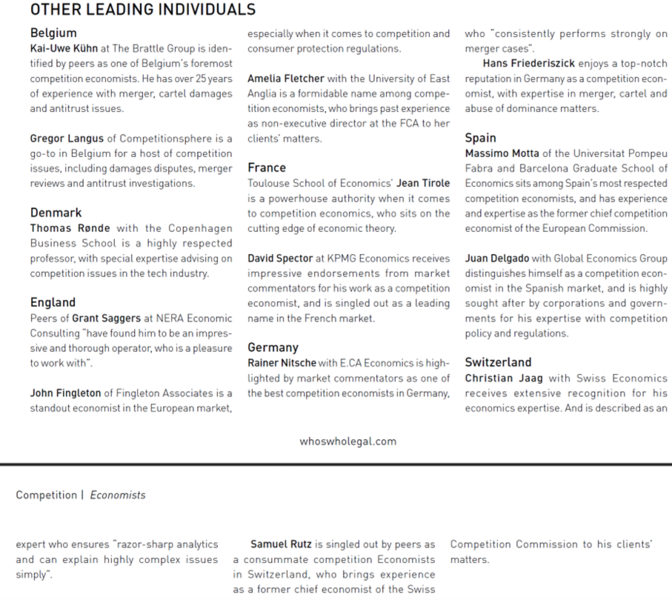
Christian Jaag and Samuel Rutz were awarded "Leading Practitioners" by WWL in the category of Competition Economics.
Every year, Who's Who Legal identifies the world's leading competition economists. This year, Swiss Economics is represented twice - by Christian Jaag and Samuel Rutz - in the illustrious circle of "Leading Practitioners" in Europe (EMEA). We would like to thank our clients for the great trust they place in us.
WWL on Christian Jaag and Samuel Rutz:
Christian Jaag of Swiss Economics receives a lot of recognition for his economic expertise. And is described as an expert who "ensures razor-sharp analyses and can explain highly complex issues simply".
Samuel Rutz is described by peers as an outstanding competition economist in Switzerland who brings his experience as former Chief Economist of the Swiss Competition Commission to bear on the concerns of his clients.

What possibilities are there for using Blockchain Technology to make processes in the creation of value with IP more secure, transparent and efficient? A study for the Swiss Federal Institute of Intellectual Property (IPI).
Intellectual property, for example in the form of patents or copyrights, protects inventors from free riders and thus creates incentives to invest more in research and development and in creative works. IP is also relevant to the rapidly developing field of Blockchain Technology and applications. IPI would like to better assess the current and, more importantly, future demand for IP-services.
As part of this study, we are conducting a survey to which we would like to cordially invite you. The outcome of this survey will be key in shaping the IPI's services related to blockchain and IP. You can participate in the survey until October 31, 2022 over the following link: www.swiss-economics.ch/ip-survey.html.
If you are active in the field of Blockchain and/or IP, we would be delighted to incorporate your opinions, experience and expertise in this study.

We have a new Logo!
Swiss Economics has a new logo. It was designed by Diego Bally and symbolizes our abbreviation "SE". The majority of its components are pointing upwards. The logo represents our development so far and our vision for the next years. Since September, it has decorated our office windows.
The new logo will be rolled out gradually over the next weeks and months. First, we will adapt our web presence, then we will implement it in our documents.
We hope you like it!

Beatrix Marosvölgyi joined our team as an Economist. Her focus lies in environmental and political economics.
Beatrix’s expertise lies in environmental economics, regulatory impact assessments and digital markets. She completed her bachelor's degree in economics at the University of Lucerne and her master's degree at the University of Bern with a focus on environmental economics. Her master's thesis focused on the change in air pollutants due to the aircraft grounding in U.S. airspace after the 9/11 terrorist attacks.
During her studies, Beatrix worked for Swiss Post, the Universities of Lucerne and Bern, and Ernst & Young. She joined Swiss Economics in 2022 as an Analyst.
She is proficient in German and English with mother tongue Hungarian.
We wish Beatrix all the best for her future at Swiss Economics.

The Center for Cryptoeconomics partners with proof-of-stake Blockchain Algorand
Swiss Economics' Center for Cryptoeconomics (cryptecon) joins the Partner Program to intensify its services in the Algorand ecosystem. Algorand is a pure proof-of-stake blockchain focused on the convergence between decentralized and traditional finance. A perfect match for cryptecon with its strong expertise in tokenomics and protocol design for DeFi projects. Previously, cryptecon already advised several Algorand projects such as Folks Finance and Pact. We are now looking forward to intensifying our efforts on Algorand and providing our services as a Preferred Partner.
Algorand creates a green Blockchain with strong focus on efficiency and is exclusive Blockchain Partner of FIFA’s Men’s World Cup 2022 and official Sponsor of FIFA’s Women’s World Cup 2023.

More about Algorand.

We are pleased to announce that Nicolas Greber has joined the team as an Economist. His focus is on competition economics and data-driven analysis including artificial intelligence.
Nicolas Greber holds a bachelor's degree in economics with a focus on industrial economics from the University of Bern. He is currently completing his Master's degree in Economics at the University of St. Gallen with a thesis on the impact of artificial intelligence on competition.

How to design a Swiss Innovation Fund?
The Federal Council wants to strengthen Switzerland as a location for start-ups. On June 22, 2022, it made a decision in favour of a Swiss Innovation Fund. This is intended to improve the financing ecosystem of start-ups during the growth phase (to the press release).
In this context, Swiss Economics was commissioned by SECO to conduct a study on the fundamentals of such an Innovation Fund. The focus was on identifying international best practices and evaluating possible governance options for a Swiss Innovation Fund (Swiss Economics report).

The Irish Commission for Aviation Regulation has published its draft decision on the maximum level of Airport Charges at Dublin Airport over the 2020-24 regulatory period. For the allowed rate of return on capital, the authority has relied on a report prepared by Swiss Economics.
Our report reflects that financial markets are currently undergoing exceptional times. Real government bond yields have fallen to a historically low level in the past couple of years, suggesting that the real expected return from risk-free assets is currently negative. Traditional approaches to estimating the cost of capital may fail to adequately capture the peculiarities of this new market environment. Hence, we assessed whether the ECB’s recent halt of quantitative easing is likely to have a significant effect on the market and analysed whether financial markets expect bond yields to rise again in the near future. Also, we considered evidence that expectations on equity returns may be more stable over time than underlying risk premia, indicating a so-called Total Market Return approach may be preferred over the traditional Equity Risk Premium approach to estimate the cost of equity.
The full report can be downloaded from the Commission for Aviation Regulation’s website.

Does digitalization require new rules for the international taxation of companies? OECD and the European Union try to change international tax law in favour of countries where consumption takes place.
In der aktuellen Ausgabe der Zeitschrift für Europarecht hat Christian Jaag zusammen mit Luzius Cavelti einen Leitartikel zum Thema «Die Bedeutung der Digitalisierung für das internationale Unternehmenssteuerrecht» publiziert.

At the inaugural Who's Who Legal Switzerland Awards ceremony on April 3, 2019, in Zurich, Christian Jaag received the Competition Economists Switzerland Expert of the Year 2019 Award. Each year Who's Who Legal presents awards to individuals that have performed exceptionally well in each of the featured practice areas according to Who's Who Legal's research.
Who's Who Legal finds that "at Swiss Economics, Christian Jaag is definitely a brilliant economist to work with according to sources. They note he is the strongest competition economist in Switzerland and enjoys a very good reputation for his work in the field."
To the article.

Michael Funk recently gave his interpretation of the influential Post Denmark II decision to an audience at the Annual Conference of the Leibniz ScienceCampus 2019 Mannheim Centre for Competition and Innovation (MaCCI).
At the Annual Conference of Mannheim Centre for Competition and Innovation, Michael Funk presented a Swiss Economics research paper on competition economics. He argues that a notional as-efficient competitor, often used in the economic assessment of abuse of dominance cases, can be too efficient to be of relevance in practice. In particular, joint costs, which are required to comply with a Universal Service Obligation, should not be considered sunk when determining the cost structure for other services or else there is a risk of imposing unrealistic efficiency standards on competitors.

Bundesnetzagentur published the latest benchmarking report by Swiss Economics. In the report, methodical details are carried out and the results are documented.
Swiss Economics, together with SUMICSID and IAEW carried out an efficiency comparison of electricity distribution system operators in the third regulatory period. Analyzed in detail was, among others, the illustration of decentralized generation. The published draft contains all important methodical aspects and documents the results. For the benchmarking, around 200 system operators were compared based on their cost efficiency. The final version will follow after the system operators have had the opportunity to comment on the draft.

Swiss Economics and COMCO present a case at the Annual conference of the Association of Competition Economists (ACE)
Screening tools can mitigate the dependency on whistleblowers and leniency applicants and enable the authorities to fight against bid rigging cartels proactively. The Investigation "See Gaster" in Switzerland was triggered by an ex-ante screening method developed by the Swiss Competition Commission. In the session, Yavuz Karagök (ComCo), Frode Steen (Norwegian School of Economics) and Michael Funk (Swiss Economics) discuss the strengths and weaknesses of screening methods with a concrete example.

Swiss Economics analyses the impact of the sharing economy on public transport.
Swiss Economics has investigated the impact of the sharing economy on public transport together with the University of Lucerne. Based on our discrete choice experiments we conclude that regulations are critical for the expected modal split.

Samuel Rutz's article «Screening for «Bid Rigging Does it Work?» was recently published in the Journal of Competition Law & Economics.
The article discusses a screening method to detect bid rigging cartels. Based on the findings of the authors, the Swiss Competition Commission (COMCO) opened an investigation and sanctioned several firms for bid rigging.

Christian Jaag was named «leading expert» in the categories Legal Competition and Consulting Experts. Samuel Rutz was honoured as a «future leader» in the categories of Competition and Consulting Experts.
Dr. Christian Jaag and Dr. Samuel Rutz have recently been featured in Who's Who Legal 2018.
Christian is listed in Who's Who Legal: Competition as a leading economist. WWL says: «Christian Jaag is a superb competition economist who is regularly called on to advise both public and private-sector clients on strategy, regulation and policy.»In addition, he is listed in Who's Who Legal: Switzerland. WWL writes: «Christian Jaag is widely recognised as «a leading competition economist» and impresses peers with his «highly creative, precise and hands-on approach», as well as his «impressive theoretical and practical skills». Lastly, Christian is listed in Who's Who: Consulting Experts.
To Christian's biography on WWL
Samuel is listed as a future leader in Who's Who Legal: Competition and Who's Who Legal: Consulting Experts.

The article «The more economic approach to predatory pricing» was recently published in the Journal of Competition Law & Economics.
Abstract: The «more economic approach» was introduced to antitrust to achieve a more effect-based and theoretically grounded enforcement. However, related to predatory pricing it resulted in systematic over- and under-enforcement: Economic theory does not require dominance for predation to be a rational (and harmful) strategy, although an ex-ante dominant firm would often refrain from predation. Hence, within the current legal framework which requires dominance for antitrust to apply, a more effect-based and theoretically grounded antitrust enforcement cannot pursue harmful predation. Therefore, we suggest separating predatory pricing from the exclusionary abuse of a dominant firm, both legally and analytically. Instead, predatory pricing should be analyzed along the same logic as a merger. In particular, we argue that three elements from merger control should be adopted: in the absence of dominance, market share and/or turnover thresholds may serve as a de minimis rule; recoupment should be analyzed similarly to the competitive effect of a merger between the predator and its prey, and a stronger efficiency defence should be established.

The partnership with OCA strengthens Swiss Economics' competencies in the areas of calculation of damages. OCA will also allow us to more effectively support clients in multinational and multilingual disputes.
Swiss Economics is delighted to announce the recently established partnership with French audit and consulting firm OCA. This new collaboration strengthens our capacity to offer multi-jurisdictional and multilingual dispute resolution services.
OCA has successfully assisted its clients during commercial and financial arbitration and litigation across various countries. The firm's technical capabilities in the area of Corporate Finance and Valuation perfectly complement Swiss Economics' skills in Competition Economics and Industrial Organisation. In collaboration with OCA, we are able to offer our clients both, top-down empirical and conceptual economic evidence as well as detailed bottom-up asset valuation, leading to even more robust results.
In addition, the partnership will allow us to ramp up large-scale case teams proficient in German, French, and English and be able to provide our clients with rigorous analysis under tight time constraints.
For more information, please contact Swiss Economics Managing Partner Christian Jaag or OCA Chairman Mikaël Ouaniche.

We welcome two new team members.
Melanie Häner is a Consultant working on economic policy and competition projects

A lecture by Christian Jaag.
A lecture by Christian Jaag.